
Unit General Operating Procedures
CHAPTER 1 Operating Procedures
1.1 Initial Clearance
1.1.1 Departure Clearances
All traffic from within the LLLL FIR will depart on a standard departure, either IFR, CVFR, or Military ATS, as detailed in the SOP.
Elsewhere, clearances shall be coordinated with the relevant Radar position whose departure is within their area of responsibility
1.1.2 Arrival Clearances
Aircraft inbound to airfields within the Tel-Aviv FIR should be cleared for their route/STAR by the sector that controls them before entering the TMA/CTR of their destination airport.
The responsibility for issuing said clearance varies depending on the sector being controlled, according to the table below:
| Sector | Destinations |
| Tel-Aviv ACC |
LLBG (arrival from the west) LLHA (International) |
| Pluto ACC |
LLIB LLHA (Domestic) |
| South ACC |
LLER LLBG (arrival from the south) |
1.1.2.1 Confirmation of STAR by Flight Crew
When an aircraft is transferred between Tel Aviv -> Ben Gurion, there is no need to report STAR. They are expected to continue to fly their flight-planned route.
If the previous controller has instructed the aircraft to fly a heading, the pilot will report the heading.
Where the reported STAR is correct, the controller does not need to reiterate the STAR to the pilot. Their report may be taken as confirmation that the pilot will follow the STAR, as reported.
Where the reported STAR is incorrect, the controller shall proceed as follows:
- If the routing and STAR need amending, the controller shall pass the routing and STAR instruction to the pilot in full and receive a full readback and confirmation that they can follow said route.
- If the STAR is from an outdated AIRAC cycle, the controller shall ascertain whether the pilot has the updated/correct STAR, and if yes, re-clear them on this up-to-date STAR.
If the pilot does not report the correct STAR, the controller shall pass the route to the aircraft and obtain a readback.
1.2 Use of "Expect level" Clearances
Many published STAR charts advise pilots of the levels that they should expect ATC to issue. Agreements between
Split sectors often require that certain climb/descent profiles be adhered to maintain the correct
sector coordination sequence.
- Normally, use a single transmission where the expected flight level – for
example, “ELY2431, expect 10,000 level by AMMIT, report when ready for descent”
1.3 Holding Phraseology
To reduce instances of incorrect direction holding, controllers are to use the following phraseology when
instructing aircraft to hold: “(callsign) hold at (name), (left/right) hand turns, (as published)”.
For example: “ELY40 hold at PIKOG, left-hand turns, as published”.
If there is no published hold or the direction given differs from the published hold, controllers shall also
specify the inbound course and leg time/distance.
If the pattern is used while the traffic is descending or climbing, you may add at the end of the instruction the altitude clearance, for example: “ELY2431 hold at AZERE, right-hand turns, as published, descend to FL210”.
1.4 Assumption of Electronic Aircraft Tags
The following procedures apply to all transfers of aircraft tags (Israel's internal & external).
1.4.1 Between Radar-Equipped Controllers
Controllers shall only ‘accept’ the transfer of an aircraft tag from a sending controller when the aircraft has
‘checked in’ on the receiving controller’s frequency
The transfer of an aircraft tag from a LLLL radar-equipped unit to another LLLL radar-equipped unit shall indicate
to the receiving controller that the aircraft has been identified, their Mode A code validated, and their Mode C
readout verified. However, aircraft outside of controlled airspace received from APC units should be instructed
to squawk IDENT in accordance with section 1.5.2 below.
1.4.2 Aircraft from Unstaffed Airspace
For aircraft coming from unstaffed airspace, controllers should assume the tag after sending a ‘contact me.’
request. This signals to other controllers that they are trying to contact the aircraft.
1.4.3 Departures
Controllers should not assume aircraft tags for departures until they have checked in on the frequency.
Additionally, tags of departing aircraft will not be assumed by APP controllers unless it is their responsibility to
complete identification, validation, and verification (IVV).
1.5 Surveillance Procedures
In general, the transfer of an aircraft’s tag from a LLLL radar-equipped unit to another LLLL radar-equipped unit
shall indicate to the receiving controller that the aircraft has been identified, its Mode A code validated, and
its Mode C readout verified.
1.5.1 SSR Code Allocation
Code allocation for non-local traffic is managed by the TOP-SKY Plugin. Departures joining the ATS\CVFR route
network transferred to the Area control center (ACC) from units using local SSR codes should be allocated a new general code.
For example, traffic departing Herzliya northbound with 5102 (T\A 8 SSQ).
1.5.2 Validation of SSR Mode A Codes
The display of a DUPE error (indicating a non-discrete code) on any aircraft’s tag requires the controller to
identify and validate the aircraft’s identity before issuing executive instructions, except for an initial
climb. The controller shall assign and validate a new, discrete Mode A code as soon as practicable and before transferring the aircraft to the next controller.
CHAPTER 2 Provision of Air Traffic Service
2.1 Roles and Responsibilities
▪ Provide the appropriate ATS within their stated Area of Responsibility (AoR) to ensure a safe, orderly, and expeditious
flow of air traffic.
▪ Provide Flight Information Services (FIS) where appropriate.
▪ Verify flight data, including updating and managing the flight progress strip (data block).
▪ Maintain a listening watch and conduct standard radiotelephony communication with aircraft.
▪ Provide ATS to aircraft using radar within the airspace of the relevant AoR and FIS, as
appropriate, in accordance with local procedures.
▪ Where appropriate, identify aircraft, validate, and verify SSR data on first contact or as soon as
possible thereafter.
▪ Assist aircraft in an emergency (except where the simulation of the emergency is denied in
accordance with VATSIM Code of Conduct B63).
▪ Coordinate with Military ATC as required.
▪ Individually coordinate the movement of aircraft into and out of the sector unless said aircraft are operating under the terms of a Standing Agreement.
▪ Issue releases to airfields as appropriate.
▪ Allocate or obtain levels at holding stacks.
▪ When necessary, initiate a suspension of local Standing Agreements.
▪ Issue clearances to aircraft to join, leave, or cross regulated/controlled airspace.
▪ When aircraft are accepted into the sector, ensure separation exists in accordance with this
SOP.
▪ Confirm all data transfer, revisions, and estimates have been effected as required in the local
instructions
2.2 Flight Information Services
Controllers shall provide Flight Information Service (FIS) to all known aircraft within their Area of Responsibility (AoR) in accordance with Israel AIP (PAMAT) "א-07." This service includes:
-
Weather Information: Providing information regarding known severe weather conditions.
-
Navigation Assistance: Assisting pilots who observe severe weather and request to deviate from their route. The controller shall facilitate the deviation while considering safety limitations and current air traffic.
2.3 Area Control Service
2.3.1 General Operating Requirements
-
Clearances: Any pilot operating within controlled airspace is mandatory to obtain a clearance from the appropriate ATC unit before executing any action that requires such clearance.
-
Inability to Comply: Pilots who are unable to comply with an issued clearance must immediately notify the ATC unit and request an amended clearance.
-
Flight Plans: All flights within the Tel Aviv FIR must file a flight plan and obtain an ATC clearance, maintaining continuous radio contact with the relevant unit.
-
Cruising Levels: IFR cruising levels must be maintained in accordance with the Table of Cruising Levels in AIP ENR 1.7.
2.3.2 Coordination of Special Activities and Emergency Simulations
Certain activities require specific coordination and prior approval from the ATC unit before they can be initiated:
-
Emergency Simulations: Practices of abnormal situations (e.g., forced landings, priority requests, communication failures, or loss of orientation) within a CTR or on traffic routes must be coordinated and approved as a simulation before commencement.
-
Special Flights: Formation flights, calibration flights, and photography flights require prior coordination and approval from the ATC unit.
2.4 Prioritisation of Services
-
Controllers shall prioritise the provision of services as follows:
-
Emergency Situations: Aircraft in a state of emergency or those executing an approved emergency simulation.
-
IFR Traffic: Provision of Air Traffic Control service to IFR flights operating on ATS routes.
-
CVFR/VFR Traffic: Provision of services to controlled VFR flights within their defined areas.
-
Information Services: Provision of Flight Information Services (FIS) to other participating aircraft.
-
2.4.1 Top-Down Service Provision
In the absence of local ATC, Area Controllers shall provide a top-down service at aerodromes within their AoR
where an Air Traffic Control service would normally be provided. Provision of ATS to airborne traffic should generally take priority over top-down service provision.
Where necessary, controllers may reduce the extent of the top-down service by permitting aircraft to self-manoeuvre or depart at their discretion. Aircraft should be instructed to maintain a listening watch on the frequency and must not be transferred to Unicom.
While some top-down service degradation is permitted, when the overall traffic workload (En Route and top-down) is such that safety, efficiency, or the experience of pilots is compromised, Area Controllers are to reduce
their coverage area. It is recognised that during events, reducing coverage may not be possible.
CHAPTER 3 Local Separation Standards
3.1 General
Separation shall be applied in accordance with Israel AIP Part "א" Section א, Chapter 1, Separation
Standards.

Standard vertical or horizontal separation shall be provided between:
- IFR flights and VFR flights;
- IFR flights and other IFR flights
- Special VFR flights and other Special VFR flights.
3.2 Vertical Separation
Vertical separation exists when the vertical distance between aircraft is never less than the prescribed
minimum. The vertical separation minima are:
- Between aircraft flying subsonic:
- Up to FL410 apply 1000 ft;
- b. Above FL410, apply 2000 ft.
- Where at least one of the aircraft is flying supersonic, the vertical separation required is 5000ft

3.3 Separation Based on ATS Surveillance System Information
3.3.1 Radar Separation Minima
The standard minimum horizontal radar separation to be applied across all of LLLL sectors is 5 NM, except LLBG_APP
where the use of 3 NM has been approved.
Where there is a requirement for an increase in separation or spacing between aircraft before transfer, this
shall be noted in the relevant section(s) of this document.
3.3.2 Ensuring Radar Separation
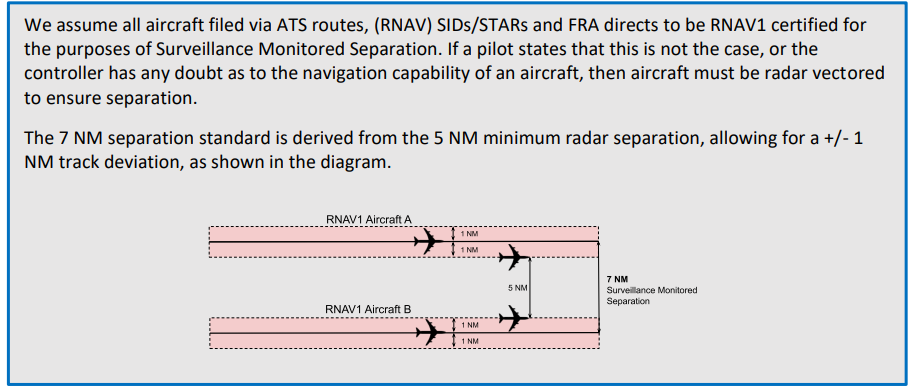
The minimum radar separation is an absolute minimum. Therefore, aircraft should not be permitted to fly on
their own navigation where the minimum separation is not ensured. As a guide, it is recommended that where
planned separation is less than 10 NM, aircraft should be on assigned headings to ensure separation. This may
be reduced to 7 NM where the use of 3 NM lateral separation has been approved.
It should be noted that due to the nature of VATSIM, headings may need to be assigned where planned
separation is greater than required, where there is the possibility of differing aircraft performance. When
operating at or close to the radar separation or surveillance monitored separation minima, controllers shall
monitor the flights for any unforeseen discrepancy.
Greater separation may be required for wake turbulence separation purposes.
The use of adequate speed control may be used in place of headings for aircraft flying in trail.
3.3.2 Surveillance Monitored Separation
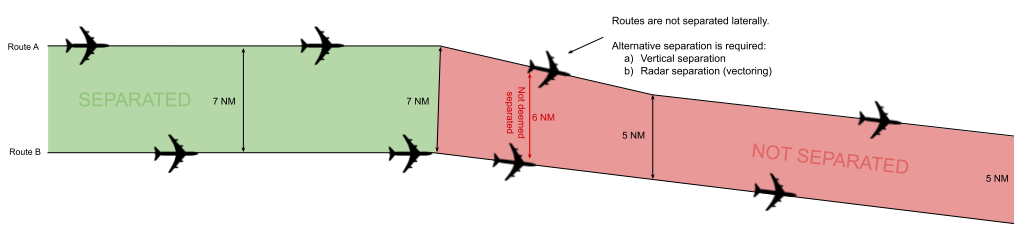
Radar monitoring of traffic on ATS routes (including SIDs, STARs, and associated holds) or FRA directs is
permitted, subject to the following conditions:
- Traffic must be established on the route centreline, or following radar vectoring / within FRA, more
than 7 NM (or 5 NM where 3 NM radar separation is approved) from the adjacent route and cleared
to a navigational fix. - Aircraft must be radar vectored if any significant route deviations are observed by the controller.
- Where turbulence or weather systems are reported, the controller must consider re-establishing
Positive radar control to counter track deviation. - Controllers should, where possible, ensure that the routes’ centrelines or the associated navigational
fix’s symbols are displayed when radar monitoring is in use.
3.3.3 Use of 3 NM Radar Separation
The use of 3NM Radar separation is approved only at LLBG_APP
3.4 Wake Turbulence Separation Requirements
Minimum of 5 NM between a HEAVY (including a SUPER) and a MEDIUM (UPPER and LOWER), SMALL
or LIGHT aircraft following or crossing behind at the same level or less than 1,000 ft below.
3.5 Minimum Separation Between Sectors
Controllers shall not route or vector unknown traffic closer than 2.5 NM from a sector boundary without prior
coordination with the adjacent sector controller.
3.6 Separation Requirements Against Holding Aircraft
A minimum of 5 NM radar separation shall be applied between holding aircraft and en-route aircraft/aircraft
approaching the holding facility. This may be reduced to 3 NM radar separation, provided that all conditions are met
relating to its use are met.
Note: Controllers should use caution when applying radar separation to aircraft approaching/passing
other holding aircraft, considering factors such as variable rates of climb/descent, hold entry patterns,
hold protected areas, and weather conditions (particularly prevailing wind).
CHAPTER 4 ALTIMETER SETTING PROCEDURES AND METEOROLOGY
4.1 Altimeter Setting Procedures
4.1.1 Transition Altitude
|
Transition Altitude |
Area |
|
18,000ft |
Above the Mediterranean Sea |
|
37,000ft |
Above Land |
CHAPTER 5 GENERAL COORDINATION REGULATION
5.1 Standing Agreements
A Standing Agreement is a procedure specifying conditions (and restrictions, as required) under which an
aircraft may enter another sector/controller’s airspace without individual coordination.
Aircraft must be individually coordinated when they cannot be transferred in accordance with a Standing
Agreement and are not deemed coordinated. Controllers may agree on temporary (amendments
to) Standing Agreements.
5.1.1 Conditions
An aircraft operating under a Standing Agreement shall be:
- cleared to, or at, an agreed level before transfer of communication; and
- on an agreed route or heading.
5.1.2 Transfer of Control and Communication
Unless specific restrictions are specified in the agreement, transfer of control of the aircraft under the terms of a
Standing Agreement is coincident with the transfer of communication.
The offering controller must ensure that any potential conflict with aircraft either in or entering their own
airspace is resolved before transfer of communication.
The receiving controller must continue the flight in the same general direction, not climb a descending aircraft
or descend a climbing aircraft, nor stop the aircraft at an intermediate level while it remains in the offering
controller’s airspace.
If traffic on a Standing Agreement will pass through an intermediate controller’s airspace without
communication (e.g., LLHA departures to the west (transfer to Tel Aviv but passing through Pluto)), transfer of control is normally effective at the receiving controller’s AoR boundary. Unless otherwise stated, any turns or climb/descent must be
coordinated with all controllers concerned.
5.1.3 Release for Climb or Descent
When transferred under a Standing Agreement, traffic is released for climb/descent (never both) to the
top/bottom of the offering controller’s airspace, unless the agreement specifies otherwise. On VATSIM, this
allows climb/descent into bandboxed sectors, but not for the traffic to enter another controller’s airspace.
Note: Traffic that has entered the receiving controller’s airspace must not then re-enter the offering
controller’s airspace during further climb or descent. This is more likely in bandboxed scenarios.
5.1.4 Release for Turn
When transferred under a Standing Agreement, traffic is released for a turn in the same general direction
against known traffic, including if transferred on a heading, and unless the agreement specifies otherwise. The
receiving controller must be informed if an aircraft is transferred on a heading against traffic, unknown to
them. Any turn must not take the aircraft into a third controller’s airspace without prior coordination.

If a release for turn is individually or electronically coordinated for an aircraft, the turn must not be greater than
than 45, unless a specific direction is agreed.
5.1.5 Level By Instructions
If no “level by” point is specified, the level must be reached prior to the aircraft entering the receiving sector.
However, the traffic does not have to be level at the time of the transfer of communication.
A climbing/descending agreement is indicated by an arrow. This means the aircraft does not need to be level
by the sector boundary and may continue to climb/descend to that level within the next sector’s airspace.
↑↓ | Indicates a climbing/descending agreement.
Where specified in an agreement, the “level by” point should be included in the descent clearance to ensure
the correct sector sequence. If the level specified cannot be achieved by the aircraft, the pilot in command
shall inform ATC immediately. ATC is responsible for further coordination with the appropriate sector(s).
Where an agreement for climbing outbounds specifies a level-by-point, controllers shall monitor the climb rate
and intervene/coordinate as required. Optionally, the “level by” point may be specified in the clearance.
5.1.6 Additional Coordination Requirements
If an aircraft that would normally be transferred to a sector on a Standing Agreement is routed to avoid that sector
entirely, controllers should notify the original sector that the traffic has been ‘skipped’.
Aircraft following a route for which an inbound Standing Agreement exists, but at a level higher than the
aircraft’s RFL must be individually coordinated.

5.2 Deemed Coordination of En-Route Traffic
Traffic that has reached the RFL indicated on the flight plan by the sector boundary is deemed to have been
coordinated and may be transferred by silent handover, provided that:
- The aircraft is at a correct level for the direction of flight;
- The RFL has not been changed within 30 NM of the AoR boundary; and
- No objection has been raised by the receiving controller.
Where the RFL is unusually low for the flight planned route, controllers should notify these flights to the next
sector individually.
Transfer of Control is at the receiving sector boundary, unless otherwise stated in this document.
5.3 Individual Coordination
Flights not deemed coordinated or subject to a Standing Agreement must be individually coordinated between sector controllers. An exit flight level should be offered, and other conditions may optionally be applied.
Departures from aerodromes not covered by Standing Agreements must also be allocated a level for
acceptance from the aerodrome/approach controller by the receiving sector.
Allow the receiving sector to identify the traffic before presenting the coordination request.
5.4 Transfer of Control and Communication
Unless otherwise stated in this document:
- transfer of control is effective at the common AoR boundary between the offering and receiving controllers
- transfer of communication shall take place no later than the sector boundary.
Aircraft must not enter a third controller’s airspace without coordination. This applies to all climb/descent and turn procedures detailed below and in sector instructions.
5.4.1 Release for Climb or Descent
Aircraft that are climbing/descending are released for climb/descent to the top/bottom of the transferring controller’s airspace.
5.4.2 Release for Turn
Traffic transferred on its own navigation is released for turn in the same general direction.
If an aircraft not operating under the terms of a Standing Agreement is transferred on a heading, any change
of heading, before entering the receiving controller’s airspace, must be coordinated unless otherwise
specified in sector procedures.
It is the responsibility of the receiving controller to ascertain if an aircraft is on a heading, and it should be
noted that aircraft may be transferred on a heading against traffic, unknown to the receiving sector
If a release for turn is individually or electronically coordinated for an aircraft, the turn must not be greater
than 45, unless a specific direct is agreed.
5.4.3 Full Release
A full release is an authorisation for the accepting unit to climb, descend and/or turn a specific aircraft according to the instructions above.
5.4.4 Conditions of Transfer
Aircraft transferred on a heading or with a speed restriction should have this recorded in the tag, with the pilot instructed to report their assigned heading and/or speed upon transfer of communication.
5.5 Handover
5.5.1 Silent Handover
Unless otherwise stated in this document, transfer of control between a enroute controller and an external
ACC may take place by means of a Silent Handover (that is, without prior coordination) provided that:
5.5.2 Radar Handover
Where the conditions for Silent Handover are not met, transfer of control by radar handover, the transferring controller will transfer the TAG of Said traffic and wait for acceptance; only then may the transferring controller transfer the control of the traffic.
- If the aircraft concerned are following the same route, they are spaced by a minimum of 10 NM,
constant or increasing. (See Note). - If the aircraft concerned are on crossing tracks, the conditions detailed under (Reduced) Longitudinal
Separation for the relevant ACC is met. - The transferring controller places any speed control or vectoring instructions (within the terms of the
agreement) in the tag and instructs the aircraft to report these on first contact with the receiving
controller. - The receiving controller is informed, by means of XFL electronic coordination or otherwise, of any
level restriction other than an aircraft’s requested flight level or those covered by Standing
Agreement prior to transfer of communications.
Note: The 10 NM here is not a separation standard. It is the minimum spacing required for a silent transfer of control.
5.6 Coordination of Direct Routings
There is no requirement to coordinate a direct routing for an aircraft, provided that the direct issued:
- Is entered in the data block label and/or EuroScope sector list;
- Ensures the aircraft will enter the receiving sector at the boundary with the offering sector, not
through an intermediate sector; and - Will not take the aircraft off route by more than 5 NM in the next or any subsequent sectors, or
contravene any positioning requirements specified in a Standing Agreement.
If any of the above conditions cannot be met, coordination shall be effected by the offering sector with the
receiving sector, the original receiving sector if that has changed, and any intermediate sectors through which
The aircraft will transit.
5.7 Electronic Coordination
Electronic coordination requires less time to perform (usually a few seconds) and generally lower controller
workload.
Releases between controllers may be specified via the TOPSKY Plugin Enroute Release tag item.
Additionally, some neighbouring ACCs use TopSky, which has release functionality.
The main limitation of EuroScope electronic coordination is that they are only applicable to pre-defined
scenarios and can only be initiated by one adjacent controller. Also, it is not suitable for time-critical situations
where a timely response is essential

Where electronic coordination is used to agree a transfer level, this level is always assumed to be the level by the
coordination point (or sector boundary if no defined point).
5.8 Handing Over/Taking Over an Operational Position
A Controller taking over a position must be fully aware of all relevant information before they
accept responsibility for the operational position.
Controllers are recommended to use one of the following checklists as an aid when handing over and
taking over sectors.
5.8.1 WEST
|
W |
Weather |
Turbulence |
|
CB Activity |
||
|
SIGMETs |
||
|
Winds |
||
|
Pressure Settings |
||
|
Runway(s) in Use |
||
|
E |
Equipment |
RT/Intercom systems |
|
ATIS |
||
|
S |
Situation |
Military Activity |
|
Holding |
||
|
Flow restrictions (e.g., MDI) |
||
|
Staffing/Adjacent ATC |
||
|
T |
Traffic |
Traffic on frequency |
|
Pending Traffic |
||
|
Potential Traffic Conflicts |
5.8.1 PRAWNS
|
P |
Pressure |
Pressure Settings |
|
R |
Roles |
Area Sectors – bandboxed? Splits? Frequencies? |
|
Top-down responsibilities |
||
|
A |
Airports |
Runways |
|
W |
Weather |
Turbulence, CB Activity, SIGMETs |
|
Avoidance |
||
|
Winds |
||
|
N |
Non-Standard Info |
Holding |
|
Flow restrictions (e.g., MDI) |
||
|
Amended or cancelled standing coordination |
||
|
Military Activity |
||
|
S |
Situation |
Transfer of TAGs |
|
Coordinated traffic |
CHAPTER 6 TOP-DOWN COVERAGE
In the absence of the local ATC, the responsibility for top-down control is determined as follows:
|
ID |
Sector/Position |
|
TLV |
Tel-Aviv Bandbox |
|
TLV_D |
Tel-Aviv Departures |
|
TLV_A |
Tel-Aviv Arrivals |
|
BGN_A |
Ben Gurion Arrivals |
|
BGN_D |
Ben Gurion Departures |
|
BGN_T |
Ben Gurion TMA |
|
PLT |
Pluto |
|
PLT_W |
Pluto West |
|
PLT_E |
Pluto East |
|
STC |
South |
|
Aerodromes |
Top-Down Priority (Left to Right, High to low) |
|
Ben Gurion (LLBG) |
BGN_D –BGN_T - TLV_D – TLV |
|
Eilat (LLER) |
STC – TLV |
|
Rosh Pina (LLIB) |
PLT_E - PLT – TLV_A - TLV |
|
Haifa (LLHA) |
PLT_W – PLT – TLV_A – TLV |
|
Herzelia (LLHZ) |
BGN_A – BGN_A – PLT_W – PLT – TLV_A - TLV |
CHAPTER 7 CIVIL/MILITARY PROCEDURES
Procedures relevant to multiple sectors are contained in this Chapter.
7.1 Apolo military control
To give a response to the following increase in mil TFC in the LLLL FIR, and to support the vIAF VSOA VATIL started applying LLMA c/s "APPOLO" and their splits "LIBA" for the north control and "SHANON" for the south control, as shown in the picture
Apolo control - Bandboxing/Splitting Procedures
|
LLMA_CTR "Apolo" 122.900 Mhz |
LLMA_N_CTR "Liba" 132.850 Mhz |
| Bandbox |
LLMA_S_CTR "Shanon" 122.900 Mhz |
7.2 Military Route Corridors
7.2.1 General Procedures
Military corridors are established to enable the transit of the ATS route structure by Military traffic
7.2.1.1 Apolo control online
When Apolo control is online, they will coordinate with the relevant ACC controller to update on transit in the corridor or closure of civil airspace (as explained in each ACC).
It is both Apolo control and the relevant ACC requirement to maintain separation from the corridor or the T\A; the priority is for military or "National Mission."
7.2.1.2 Apolo control offline
When Apolo control is offline, aircraft/formations wishing to transit a corridor will call the local ACC (Pluto\South\Tel-Aviv) at least 5 minutes prior to transit, while setting the V-LARA application as required. Traffic should be identified, and Mode C verified, and may be offered a service outside of the corridor or Training Area, depending on workload or knowledge.
Clerance should be in the following format:
"C/S Follow the Corridor at an altitude of XXXft report entering the area."
7.2.2 Sea corridor "Derech Ha-YAM" (דרך הים)
highlighted in red
Apolo control Sector: Liba
Civil Sector: Pluto\Tel-Aviv\BGN TMA\South
Transit Altitude: 12000ft - FL500 (With exception to BGN TMA, which is split as per the following photo), for transit in lower altitude, Apolo will request deligation from Tel-Aviv ACC

7.2.3 Netofa corridor "Derech Netofa" (דרך נטופה)
highlighted in blue
Apolo control Sector: Liba
Civil Sector: Pluto
Transit Altitude: 12000ft - 30000ft
7.2.4 Galil corridor
highlighted in purple
Apolo control Sector: Liba
Civil Sector: Pluto
Transit Altitude: 12000ft - FL500
7.2.5 Bikaa corridor "Derech Bikaa" (דרך הבקעה)
highlighted in steel blue
Apolo control Sector: Liba
Civil Sector: Pluto
Transit Altitude: 12000ft - FL500


7.2.6 Hahhar corridor "Derech Hahhar" (דרך ההר)
highlighted in brown
Apolo control Sector: Liba\Shanon
Civil Sector: Pluto\South\Tel-Aviv
Transit Altitude: 12000ft - FL500 (south of BGN-TMA), 18000ft - 26000ft (Above BGN-TMA)
7.2.7 Hahhar Hanistar corridor "Derech Hahhar Hanistar" (דרך ההר הנסתר)
highlighted in yellow
Apolo control Sector: Shanon
Civil Sector: South
Transit Altitude: 8000ft - 11000ft
7.2.8 Plugot corridor "Derech Plugot" (דרך פלוגות)
highlighted in desert yellow
Apolo control Sector: Shanon
Civil Sector: South
Transit Altitude: 12000ft - FL500
7.2.9 Hanegev corridor "Derech Hanegev" (דרך הנגב)
highlighted in pink
Apolo control Sector: Shanon
Civil Sector: South
Transit Altitude: 12000ft - FL500
7.2.10 Hanegev Hamurhevet corridor "Derech Hanegev Hamurhevet" (דרך הנגב המורחבת)
highlighted in Olive
Apolo control Sector: Shanon
Civil Sector: South
Transit Altitude: 12000ft - FL500