
APC | Approach Control
Chapter 1: Area of Responsibility and Sector Organisation:
1.1 General
In this section, the following conventions for the naming of the Ben Gurion Group sector
positions is adopted:
A or D - Departure or arrival
T - TMA Controller
1.1.1 Area of Responsibility
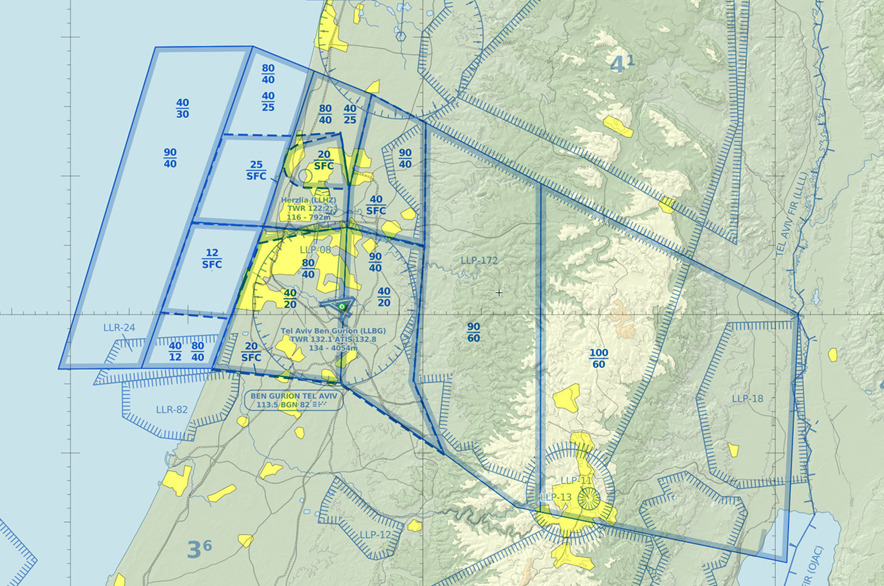
The primary area of responsibility for Ben Gurion Approach is the Ben Gurion Terminal Movement Area (TMA). The TMA is defined as a Terminal Control Area centered around the aerodrome, utilised by the approach controller to safely sequence and manoeuvre arriving, departing, and transiting aircraft.
-
Vertical Limits: The TMA extends from the specified lower limits up to a maximum altitude of 10,000 feet AMSL at its peak.
-
Airspace Boundaries: The TMA altitudes are strictly defined to separate different airspace jurisdictions. Below the TMA, the airspace accommodates local aerodromes and CVFR routes. Above the TMA lies the airspace of Tel Aviv Control (LLLL_CTR) and military (IAF) sectors. Controllers must exercise caution to ensure aircraft do not exceed the vertical limits of the TMA.
-
Top-Down Responsibilities:
-
Tel Aviv traingle Airspace: When Tel Aviv Control (LLLL_CTR) is offline, Ben Gurion Approach assumes responsibility for the Tel Aviv maritime airspace, strictly limited to traffic departing from or arriving at Ben Gurion
-
Herzliya (LLHZ): When Herzliya Tower or Pluto Control are offline, Ben Gurion Approach assumes top-down control over Herzliya aerodrome.
-
1.2 Function
BGN radar position provides services as specified in Israel AIP part "א", sections 1, 7, 5, 2, 3, for both IFR and CVFR traffic within controlled airspace.
1.2.1 Responsibility of Approach controllers (D\A APP)
1.2.1.1 D APP
-
Receiving departing aircraft from Aerodrome Control (ADC) and controlling them until transfer of control to the appropriate radar/en-route sector.
-
Provided Runway 21 is not in use, receiving arriving traffic from the radar sector and managing the sequence and radar vectoring to the active approach.
-
Coordinating with ADC regarding the required Minimum Arrival Interval (MAI) and Minimum
1.2.1.2 A APP
- Providing radar vectors or managing the sequence for ILS, Visual, or RNP approaches for Runway 21.
- Coordinating with ADC regarding the required separation between aircraft on Runway 21.
1.2.2 Responsibility of TMA controllers (T APP)
-
Sequencing, separating, and managing the TMA airspace for crossing or departing traffic.
-
Managing Herzliya aerodrome (LLHZ) and all low-level traffic.
-
Sequencing and separating traffic arriving from the east into the main arrival sequence.
1.3 BGN RADAR Bandbox/Splitting Procedures
1.3.1 Opening Order
D-APP may be staffed at all times
A-APP may be staffed only when RWY21 is in use for arrival and while there is no single RWY ops active
T-APP may be staffed after A-APP\D-APP split, or after the opening of D-APP, when RWY21 is not in use.