
LLLL - Tel Aviv FIR
Chapter 1 - General Operation Procedures
1.1 Sectors and Sector Groups
Tel Aviv control manages en route traffic in the Tel Aviv (LLLL) FIR.
Israeli airspace is divided into three main sector groups based on their geographical position.
- South control: Southbound of LLBG TMA
- Tel Aviv control: Over the sea for International flights
- Pluto control: over land north of the LLBG TMA
| VATSIM Callsign | Radio C/S | Group | Frequency |
| LLLL_CTR | Tel Aviv Control | Tel Aviv | 121.400 |
| LLLL_D_CTR | Tel Aviv Control | Tel Aviv | 122.950 |
| LLLL_A_CTR | Tel Aviv Control | Tel Aviv | 121.400 |
| LLLL_E_CTR | Tel Aviv Control | Tel Aviv | 132.025 |
| LLSC_CTR | South Control | South | 120.900 |
| LLGV_CTR | Hagav | South | 128.350 |
| LLGV_N_CTR | Hagav North | South | 128.350 |
| LLGV_S_CTR | Hagav South | South | 121.150 |
| LLPT_CTR | Pluto | Pluto | 119.150 |
| LLPT_W_CTR | Pluto West | Pluto | 119.150 |
| LLPT_E_CTR | Pluto East | Pluto | 134.650 |
1.2 LLLL Bandboxing/Splitting
The table below shows the three main groups spliiting proceduresa, including ownership of sectors.
|
LLLL_D_CTR (122.950) |
LLLL_D_CTR (122.950) |
LLLL_CTR (121.400) |
LLLL_CTR (121.400) |
|
LLLL_A_CTR (121.400) |
|||
|
LLLL_E_CTR (132.025) |
|||
|
LLPT_W_CTR (119.150) |
LLPT_CTR (119.150) |
||
|
LLPT_E_CTR (134.650) |
|||
|
LLGV_N_CTR (128.350) |
LLGV_CTR (128.350) |
LLSC_CTR (120.900) |
|
|
LLGV_S_CTR (121.150) |
|||
|
LLSC_CTR (120.900) |
|||
Chapter 2 - South control
2.1 Area of Responsibility
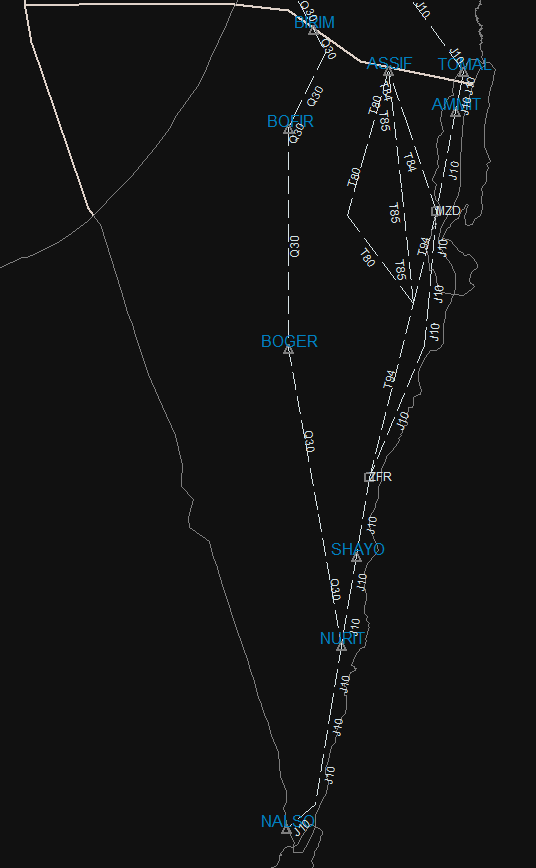
South control (LLSC_CTR) is the south sector of LLLL FIR, covering from the south line of TMA LLBG down to Eilat city.
Also in this sector are seven AF bases and a few uncontrolled airstrips. The sector is going from ground level to unlimited (if mil-certified, if not until FL370).
The sector splits mainly into Flights over the ATS route (mainly at the J10 airway, etc.) The parent unit, as shown above, is LLSC_CTR.
2.1.1 Sector Frequency
South control is operating on 120.900
2.2 General Operating Procedures
2.2.1 Common ATS traffic routing
The main traffic is either northbound or southbound, with little to no east-westbound. The traffic normally passes through the J10 airway. In the sector are some shortcuts which may be approved under the following conditions
|
Range |
Condition for approval |
Pre-Approval condition |
Identification |
|
ZFR-MZD |
none, approved and plannable |
Filed in FPL |
T94 |
|
BIRIM - NURIT |
1. Friday/Saturday 2. No military traffic active within the Q30 range
Or 1. Approval from "Apollo"\"Shanon" MIL-ACC
|
vIAF flight (VSOA remark) |
Q30 |
|
ASSIF-OBAKO |
1. Clear the area within the shortcut airway with no military traffic active (TSA Area 8)
Or
1. Approval from "applo"\"Shanon" if connected
|
CDR 2 – ONLY BY ATC |
T85 |
|
ASSIF-OBAKO |
T80 |
||
|
ASSIF-MZD |
T84 |
Remark: The bold identification may indicate the most preferred shortcuts for traffic management
2.2.2 Route restrictions
Due to a high amount of traffic in the vicinity of the south sector, most of the airways are limited to the upper limit of FL370 and the lower limit of 5000 to 6000ft.
2.2.2 ATS controlling restrictions
Due to a small maneuver area within the J10 corridor, the controller may not vector any traffic; instead, the controller MAY give direct instructions to any FIX over the route/sector.
Vectors shall be the last resort in any situation for IFR traffic
2.2.2 Initial Route Clearance and transfer of control (IFR)
South control shall issue route clearance (including STARs) in accordance with GEN 1.1. See Annex A for a list of
STARs, and as required in Chapter 2.3
2.3 Standing Agreements
2.3.1 Tel-Aviv (LLLL)
Separation: Each transfer of control will be with at least 10NM of separation between two planes with the same performance. If the lateral separation cannot be accomplished, a vertical separation of 1000ft (and steady) is required.
Altitude hold: When control is transferred to Tel Aviv while the traffic is on J10 airway, Tel-Aviv will transfer the traffic when holding coordinated altitude until leaving the said airway.
2.3.1.1 From Tel Aviv to South control
Altitude agreement
|
To |
Agreement |
Conditions |
|
LLER\LLOV |
29,000 ft at SIVAK |
20NM lateral separation (RWY19) 30NM lateral separation (RWY01) |
|
LLNV |
19,000 ft at SIVAK |
|
Transfer of control
|
Position |
Conditions |
|
DONAG |
|
|
SIVAK |
|
|
ASSIF |
If "ASSIF Shortcut" is active |
2.3.1.2 From South to Tel Aviv control
Altitude agreement
|
From |
Agreement |
Conditions |
|
LLER\LLOV |
28,000 ft at TOMAL |
Reporting 10 minutes in advance of transfer |
|
LLNV |
12,000 ft at TOMAL |
|
Transfer of control
|
Position |
Conditions |
|
YOLCO |
|
|
SIVAK |
|
2.3.2 Ben Gurion (LLBG)
Minimal Segregation zone: Both South control and Ben-Gurion will maintain a segregation zone of 2.5NM of the south border of Ben Gurion TMA (except for J10 airway or transfer of control)
WT separation from the segregation zone: When traffic that requires WT radar separation, each station will maintain half the required separation from the South border of Ben Gurion TMA
ASSIF&J10 routing: When the ASSIF shortcut is active, the J10 airway north of the join position of the shortcut will be assumed as a Northbound airway, while the approved shortcut will be assumed as a southbound airway
2.3.2.1 South to Ben Gurion
Altitude agreement
|
From |
Agreement |
Conditions |
|
ASSIF |
10,000/8,000 at ASSIF |
|
|
AMMIT |
10,000/8,000 at SIVAK |
|
Transfer of control:
|
Position |
Conditions |
|
5NM Before AMMIT |
Clear of conflict |
|
10NM Before ASSIF |
If "ASSIF Shortcut" is active and there is an entry from ASSIF |
STAR allocation: South control will allocate STAR to Ben Gurion, as explained in ANNEX A.
When no STAR is available, the south control may route the traffic with one of the following options:
1. TOMAL - ADLOD
2. ASSIF - ADLOD (If requested by Pilot or from Ben Gurion UNIT) and with the following conditions:
a. The route to ASSIF is Clear down to 8000ft
b. The traffic will be transferred as soon as possible
2.3.2.2 Ben Gurion to South
Altitude agreement
|
From |
Agreement |
Conditions |
|
LLBG\LLHZ |
9,000 ft at TOMAL/ASSIF 8000 ft at BIRIM |
*IAS of 250kts |
Required Separation: When two planes are flying southbound for an international flight, they may be transferred with 10 minutes of separation.
Transfer of control:
|
Position |
Conditions |
|
TOMAL |
Clear of conflict |
|
ASSIF |
If "ASSIF Shortcut" is active and Holding Altitude as instructed |
|
BIRIM |
If "Q30 Shortcut" is active and Holding Altitude as instructed |
2.3.3 Nevatim (LLNV)
2.3.3.1 Nevatim to South
Altitude agreement
|
From |
Agreement |
Conditions |
|
MZD (Northbound) |
↑6000 at MZD |
|
|
KINAR (Southbound) |
↑7000 at KINAR |
|
Transfer of control
|
Position |
Conditions |
|
10NM Before ENOKO |
Clear of conflict |
2.3.3.2 South to Nevatim
Altitude agreement
|
From |
Agreement |
Transfer |
|
South of KINAR |
6,000 ft at MALUQ |
|
|
North of MZD |
6000 ft at MZD |
|
Transfer of control
|
Position |
Conditions |
|
2NM south of SUKOT |
From the south |
|
MZD |
From the north |
STAR allocation: South control may not allocate any STAR to Nevatim
2.3.3 Eilat (LLER)
STAR allocation: South control will allocate STAR to Eilat, as explained in ANNEX A.
2.3.3.1 From Eilat to South
Altitude agreement:
|
From |
Agreement |
Conditions |
|
LLER SID |
↑5000ft |
RWY01 |
|
|
↑8000ft |
RWY19 |
Transfer of control:
|
Position |
Conditions |
|
Airborne passing 3500ft |
RWY 01 in use |
|
Facing North |
RWY19 in use |
2.3.3.2 From South to Eilat
Altitude agreement:
|
From |
Agreement |
Conditions |
|
SHANI |
6000ft at NURIT |
RWY01 |
|
|
6000ft at ESHEL |
ADIVI-APP RWY01 |
|
|
5000ft at NURIT |
RWY19 |
Transfer of control:
|
Position |
Conditions |
|
SHANI |
|
Approval of RNP-VIS (ADIVI\NURIT): May be approved for Israeli airline only with the request of the flight crew ONLY
2.4 Coordination and Procedures with Adjacent Units, Sectors, and Airfields
2.4.1 Tel Aviv
- Inbound traffic to Nevatim: Should be coordinated to be transferred TOMAL at a steady altitude of 17,000ft
- Inbound Traffic to SIVAK: Tel Aviv may be reported in advance of 10 minutes before crossing SIVAK
- Outbound Traffic From Nevatim: South may coordinate climbing to 14,000ft
2.4.2 Ben Gurion
- Crossing SIVAK at 6000ft may be coordinated (For traffic entering LLBG_TMA)
- Entry to South from BIRIM may be coordinated and will be approved at an altitude of 8,000ft only
2.4.3 Nevation
- Release of departing traffic: Nevatim is required to request release from South control twice for each traffic, once 5 minutes before departure and once 1 minute before departure
2.4.4 Shanon\Hagav\Appolo
When active, the following coordinations are required
- Each holding pattern on J10 airway will need to be approved via MIL-control
- Each climb before entering J10 airway will need to be approved via MIL-control
- Each departure from LLRM will be coordinated with South control
The best practise is to approve ZFR\KINAR (due to active airways)
2.5 En-route Holding Procedures
MZD Hold
When a high amount of traffic is inbound to LLBG\OJAI, and the LLBG_APP is not yet able to receive it South control may use this hold to regulate the traffic and give better separation
|
VOR hold, 1.5- minute legs |
MZD |
|
001° |
Axis |
|
Left hand |
Direction |
|
10,000-37,000 |
Holding Altitude |
|
Maximum 240 kts IAS |
Speed |
ZFR Hold
When the time separation to LLER is too tight, this pattern and the next one may be used for sequencing
|
VOR hold, 1.5- minute legs |
ZFR |
|
199° |
Axis |
|
Right hand |
Direction |
|
6,000-34,000 |
Holding Altitude |
|
Maximum 265 kts IAS |
Speed |
Shayo Hold
The second holding is used to moderate LLER traffic, lower in priority due to RNAV requirement and a higher lower limit that will require a steep descent.
Chapter 3 - North control ("Tel-Aviv ACC)
3.1 Area of Responsibility
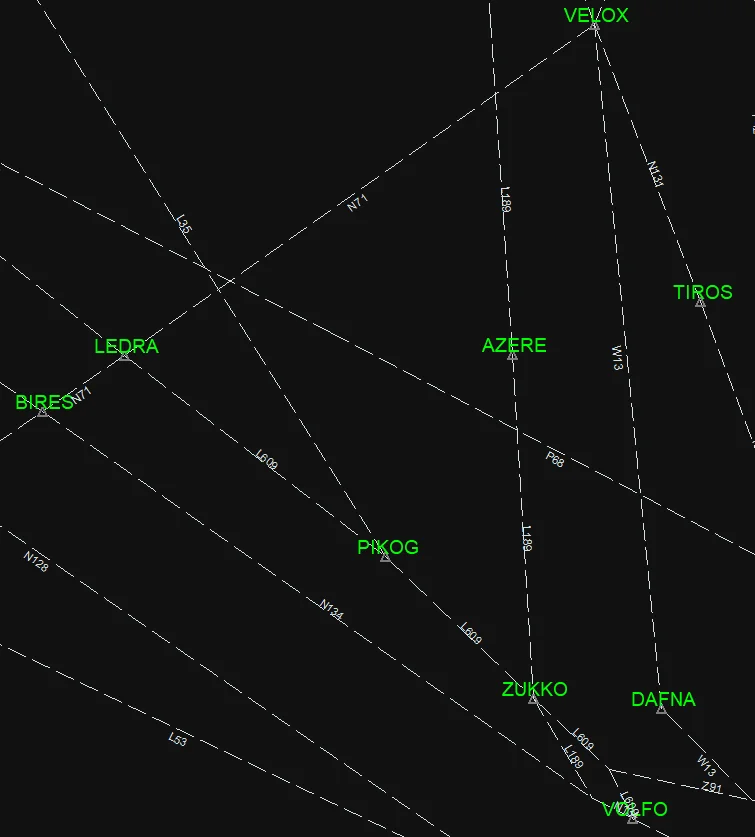
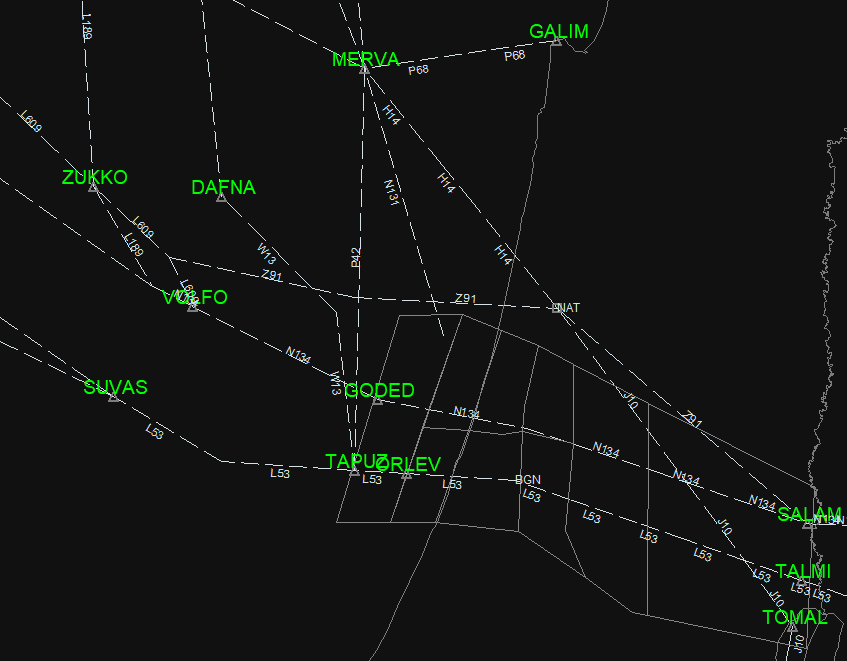
North control (LLLL_CTR) is the North sector of LLLL FIR, covering from the south line of TMA LLBG up to the northern border of the FIR above the coast and above the TMA.
The sector is splitting into 3 main sectors: Inbound to LLBG\LLHA\OJAI (LLLL_A_CTR); outbound of LLBG\LLHA\OJAI (LLLL_D_CTR); Crossing traffic at the sector.
Also, there is an area between N71 airway and zukko, "The triangle which is in deligation."
3.2 General Operating Procedures
3.3 Standing Agreements
3.4 Coordination and Procedures with Adjacent Units, Sectors, and Airfields
3.5 En-route Holding Procedures
AZERE Hold
One of two
PIKOG Hold
When the time separation to LLER is too tight, this pattern and the next one may be used for sequencing