
LLLL - Tel Aviv FIR
Chapter 1 - General Operation Procedures
1.1 Sectors and Sector Groups
Tel Aviv control manages en route traffic in the Tel Aviv (LLLL) FIR.
Israeli airspace is divided into three main sector groups based on their geographical position.
- South control: Southbound of LLBG TMA
- Tel Aviv control: Over the sea for International flights
- Pluto control: over land north of the LLBG TMA
| VATSIM Callsign | Radio C/S | Group | Frequency |
| LLLL_CTR | Tel Aviv Control | Tel Aviv | 121.400 |
| LLLL_D_CTR | Tel Aviv Control | Tel Aviv | 122.950 |
| LLLL_A_CTR | Tel Aviv Control | Tel Aviv | 121.400 |
| LLLL_E_CTR | Tel Aviv Control | Tel Aviv | 132.025 |
| LLSC_CTR | South Control | South | 120.900 |
| LLGV_CTR | Hagav | South | 128.350 |
| LLGV_N_CTR | Hagav North | South | 128.350 |
| LLGV_S_CTR | Hagav South | South | 121.150 |
| LLPT_CTR | Pluto | Pluto | 119.150 |
| LLPT_W_CTR | Pluto West | Pluto | 119.150 |
| LLPT_E_CTR | Pluto East | Pluto | 134.650 |
1.2 LLLL Bandboxing/Splitting
The table below shows the three main groups spliiting proceduresa, including ownership of sectors.
|
LLLL_D_CTR (122.950) |
LLLL_D_CTR (122.950) |
LLLL_CTR (121.400) |
LLLL_CTR (121.400) |
|
LLLL_A_CTR (121.400) |
|||
|
LLLL_E_CTR (132.025) |
|||
|
LLPT_W_CTR (119.150) |
LLPT_CTR (119.150) |
||
|
LLPT_E_CTR (134.650) |
|||
|
LLGV_N_CTR (128.350) |
LLGV_CTR (128.350) |
LLSC_CTR (120.900) |
|
|
LLGV_S_CTR (121.150) |
|||
|
LLSC_CTR (120.900) |
|||
Chapter 2 - South control
2.1 Area of Responsibillity
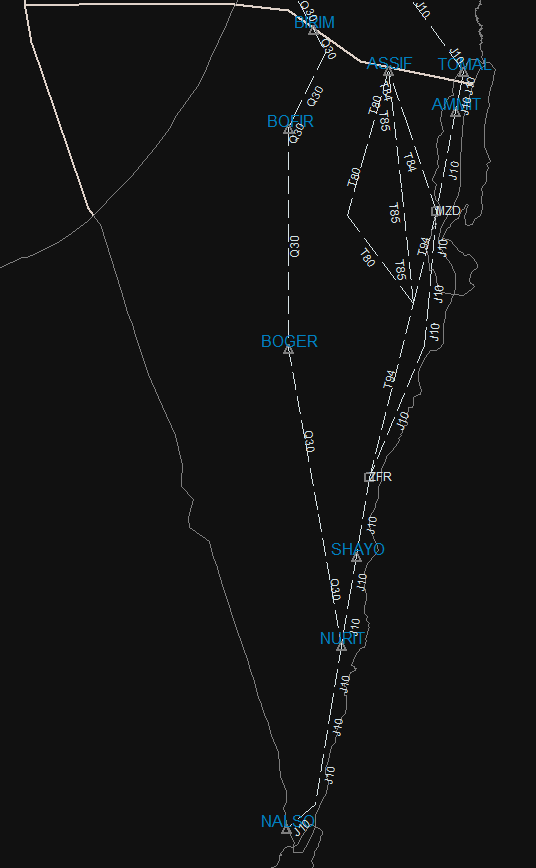
South control (LLSC_CTR) is the south sector of LLLL FIR, covering from the south line of TMA LLBG down until Eilat city.
Also in this sector are seven AF bases and a few un-controlled airstrips. The sector is going from ground level to unlimited (If mil-certefied, if not until FL370).
The sector splits mainly into Flights over the ATS route (mainly at the J10 airway etc.) Which the parent unit as showen above is LLSC_CTR
2.1.1 Sector Frequency
South control is operating on 120.900
2.2 General Operating Procedures
2.2.1 Common ATS traffic routing
The main traffic is either northbound or southbound, with little to no east-westbound. The traffic normally passes through the J10 airway. In the sector are some shortcuts which may be approved under the following conditions
|
Range |
Condition for approval |
Pre-Approval condition |
Identification |
|
ZFR-MZD |
none, approved and plannable |
Filed in FPL |
T94 |
|
BIRIM - NURIT |
1. Friday/Saturday 2. No military traffic active within the Q30 range
Or 1. Approval from "Apollo"\"Shanon" MIL-ACC
|
vIAF flight (VSOA remark) |
Q30 |
|
ASSIF-OBAKO |
1. Clear the area within the shortcut airway with no military traffic active (TSA Area 8)
Or
1. Approval from "applo"\"Shanon" if connected
|
CDR 2 – ONLY BY ATC |
T85 |
|
ASSIF-OBAKO |
T80 |
||
|
ASSIF-MZD |
T84 |
Remark: The bold identification may indicate the most preferred shortcuts for traffic management
2.2.2 Route restrictions
Due to a high amount of traffic in the vicinity of the south sector, most of the airways are limited to the upper limit of FL370 and the lower limit of 5000 to 6000ft.
2.2.2 ATS controlling restrictions
Due to a small maneuver area within the J10 corridor, the controller may not vector any traffic; instead, the controller MAY give direct toward any FIX over the route/sector.
Vectors shall be the last resort in any situation for IFR traffic
2.2.2 Initial Route Clearance and transfer of control (IFR)
South control shall issue route clearance (including STARs) in accordance with GEN 1.1. See Annex A for a list of
STARs.
2.2.3 Entery points (IFR)
|
Status of traffic |
Transferring UNIT |
Position |
|
Stable at 9,000ft at 250kts |
LLBG_APP |
TOMAL |
|
Climbing to 9000ft |
ASSSIF |
|
|
Climbing to 9000ft |
BIRIM |
|
|
Cruise altitude with 10 NM separation from each traffic |
LLLL_E_CTR |
TOMAL |
|
ASSSIF |
||
|
BIRIM |
||
|
DONAG |
||
|
YOLCO |
לערוך את שני הפרקים מעל עם הגדרה להפרדה