📃Ben Gurion
- GEN | General Operating Instructions
- GEN | BGN ADC <-> BGN APC LoA
- ADC | Aerodrome Control
- APC | Approach\Departure Control
- APC | TMA Control
- APC | BGN RADAR OPERATING PROCEDURES
- APC | ANNEX
GEN | General Operating Instructions
Required knowledge
- ANNEX 2
- ANNEX 11
- DOC 4444
- DOC 7030
CHAPTER 1 Altimeter Setting Procedures
1.1 Altimeter Setting Procedures
1.1.1 Departing Aircraft
Departing aircraft should state the ATIS INFO letter on first contact with DEL or the relevant controller. If they don't, it should be
issued by the DEL or the relevant controller. Aircraft should be informed of any subsequent change to the
QNH at the earliest opportunity.
1.1.2 Arriving / Transiting Aircraft
At or below the Transition Altitude, an aircraft’s vertical position will be controlled by
reference to the Ben Gurion QNH. Aircraft will be issued the QNH once cleared to descend to
an altitude by Tel Aviv or Ben Gurion APP. Aircraft should be informed of any subsequent change to the QNH at the earliest opportunity.
1.1.3 Transition Altitude/Level
The Transition Altitude (in the LLLL FIR) is 18,000 feet AMSL.
When flying above land, the transition altitude is set to 35,000ft.
Note: From here on, unless otherwise specified, vertical references are measured in ft are to be assumed as altitudes AMSL.
CHAPTER 2 All Weather Operations
2.1 Low Visibility Procedures (LVP)
2.1.1 Enforcement
Pilots will be informed when these procedures are in operation by ATIS or by R/T.
ATC Low Visibility Procedures must be applied when the RVR is less than 800m (or visibility below 1200 meters).
2.1.2 Runway Visual Range (RVR)
The RVR is measured at three points along each runway: at the touchdown zone, mid-point,
and stop-end. The minimum RVR that can be measured is 50 m, and the maximum is 1500 m.
Only the touchdown zone RVR value is published in METARs; the remaining two RVR
values are ‘unknown’ to VATSIM network controllers. When LVP is in force, pilots should be
informed of the reported RVR and any subsequent updates.
CHAPTER 3 Description of Airfield
3.1 Aerodrome Geographical Data
|
LLBG |
ICAO Code |
|
LAT: 320034N LON: 0345308E |
Aerodrome Reference Point (ARP) |
|
400 M from THR 30 |
|
|
134 ft AMSL |
Elevation |
|
18,000ft AMSL (SEA) // 35,000ft AMSL (LAN) |
Transition Altitude |
|
2000ft (West), 5000ft (East) |
Safety Altitude |
3.2 ATC Communication Facilities
3.2.1 Aerodrome Control (ADC)
|
Callsign |
Logon Callsign |
Abbreviation |
Frequency (MHz) |
|
Ben-Gurion Departure Information |
LLBG_D_ATIS |
ATIS DEP |
132.800 |
|
Ben-Gurion Arrival Information |
LLBG_A_ATIS |
ATIS ARR |
132.500 |
|
Ben-Gurion Clearance |
LLBG_DEL |
DEL |
121.550 |
|
Ben-Gurion Ground |
LLBG_E_GND |
GND East |
121.950 |
|
Ben-Gurion Ground |
LLBG_W_GND |
GND West |
121.750 |
|
Ben-Gurion Tower Arrival |
LLBG_A_TWR |
TWR ARR |
132.100 |
|
Ben-Gurion Tower Departure |
LLBG_D_TWR |
TWR DEP |
134.600 |
3.2.2 Approach Control (APC)
|
Callsign |
Logon Callsign |
Abbreviation |
Frequency (MHz) |
|
Ben-Gurion Approach |
LLBG_DEP |
DEP |
120.500 |
|
Ben-Gurion Approach |
LLBG_APP |
APP |
131.100 |
|
Ben-Gurion TMA |
LLBG_T_DEP |
TMA |
119.500 |
3.3 Logon Order
3.3.1 Aerodrome Control
TWR DEP is the primary tower and should be opened in the first instance. Before TWR is split,
RWY 21 must be in use, and there must not be a single RWY OP active.
GND West is the primary position, and after that, GND East may open, and only then BGN DEL.
3.3.2 Approach Control
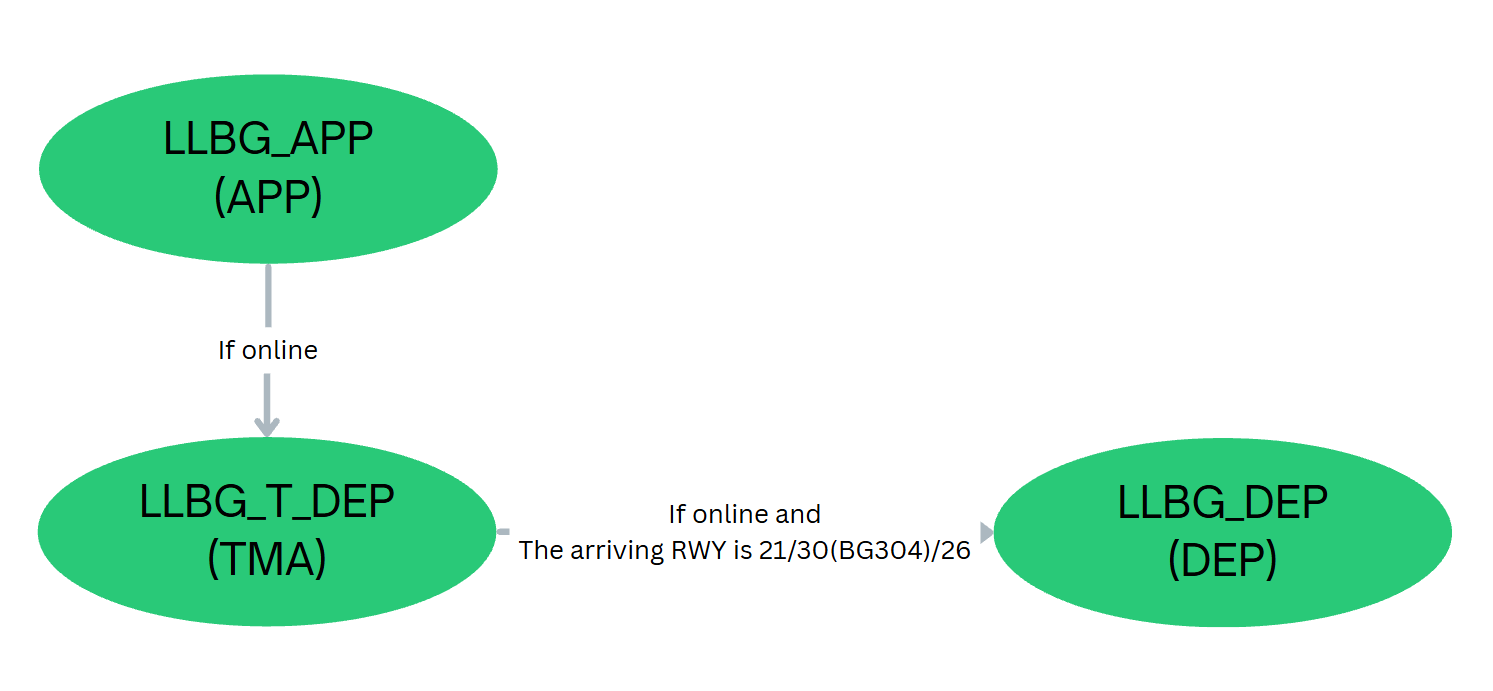
APP may be staffed at any time.
When APP is staffed, TMA may split
DEP may open only when TMA is staffed, and the arriving RWY is 21/30(BG304)/26
DEP is last in priority to be staffed
3.4 Radio Navigation and Landing Aids
|
Type |
Identifier |
Frequency (MHz) |
|
ILS 21 |
BN |
109.700 |
|
ILS 30 |
BD |
111.900 |
|
ILS 12 |
BG |
110.300 |
|
ILS 26 |
BA |
108.700 |
|
ILS 08 |
BC |
110.900 |
CHAPTER 4 Use of Runways
4.1 Preferential Runway System
Runway 26 is the preferred runway for departure.
Runway 21 is the preferred runway for arrival during the day, but due to Noise abatement procedures & winds, there is a rotation between RWY30, RWY21, and RWY12.
At night, RWY12 is the preferred runway for ARR due to noise-abatement procedures
Tailwind at or above 5KTS shall initiate a change of active ARR runway.
4.2 Change of Runway Configuration
When there is a change of runway configuration, TWR DEP shall initiate contact with DEP to agree on a last arrival and time for the runway change. DEP shall confirm with all APC stations about the change of configuration.
Based on this time, TWR DEP shall coordinate with GND\DEL as to the last departure. GND\DEL will re-clear any previously cleared aircraft that will now depart on the new runway.
TWR DEP shall inform DEP of the intended last 3 (if appropriate) departures before, and the first departure after, the runway change (callsign and routing).
DEP will inform TWR DEP when the runway change is completed.
4.3 Use of the Non-Duty Runway
Aircraft can land on the departure runway if technical or safety reasons preclude using the
nominated arrival runway or to try and avoid a missed approach.
Opposite-direction departures and approaches are not permitted except in an emergency.
CHAPTER 5 Use of STOP-BAR
Each controller shall use the system in the following procedure
TWR - The controller will turn on or off the STOP-BARS of the active runways
GND EAST\GND WEST - The controller will turn on or off the STOP-BARS of the taxiways in his Area of control or of the active runways if he has permission to cross or enter said runways.
CHAPTER 6 Priority of traffic
Controllers at BGN airport shall follow the following sequence of priority:
- Emergency - If the controller will accept the emergency
- Plane in Final approach (Instrument approach) or in Final leg in VFR approach
- Ambulance\red arrow (Military ambulance)\SAR (Search and rescue) - That traffic is not committed to CRM limitation
- Firefighting traffic - Orange Arrow
- Operational Police flights - Blue Arrow
- VIP flights - That traffic is not committed to CRM limitation
- Commercial Passengers or Cargo flights
- Non-operational Police flights
- Electrical Arrow
- Test Flight
- Agriculture Flight
- Green Arrow (IAF flight of VIP)
- General Aviation flight
- Training Flight
- Any other type
Note: When a higher-priority flight crosses a cruising flight, there shall be considered a change of altitude for the lower-priority flight.
CHAPTER 7 Relief of controller
When a controller shift change is in motion the relieving controller shall connect as relief callsign (for example LLLL__CTR instead of LLLL_CTR). When the relieving controller is connected, the relieved controller shall initiate the briefing in the following format:
| Weather conditions (Alerts, ATIS, Pilots reports) | |
| NOTAM and special information | |
| Runway configuration and sector management | |
| Runway conditions (Open\Close\Occupied) | |
| System status (ILS,GNSS,VOR) | |
| Traffic management and Traffic limitations | |
| Special Activity in the sector | |
| Traffic (Airborne, Ground, Expected) |
GEN | BGN ADC <-> BGN APC LoA
1. Method
1.1 Directioning after takeoff or go-around
1.1.1 Shall be given to the plane as clearance before departure/go-around or after departure/go-around
1.1.1.1 The heading will be given by the TWR controller with the instruction of the APC controller
1.1.1.1.1 If the heading is given for safety reasons, the TWR controller will do so at his discretion and update the APC controller about the details of the clearance as soon as possible.
1.1.1.2 Directioning is approved in the following situations:
1.1.1.2.1 Safety
1.1.1.2.2 Weather bypassing
1.1.1.2.3 Bypassing of non-RNAV-capable plane
1.1.1.2.4 Optimize routing of prop-based planes, business jets, and helicopters
1.1.1.2.5 Optimize routing of regional traffic.
1.1.1.2.6 Go Around
1.1.2 Conditions for Directioning
1.1.2.1 When departing from RWY 30 or 26, the left turn will be limited to 1000ft
1.1.2.2 When departing from RWY 30 or 26, the right turn will be limited to 600ft
1.1.2.3 When departing from RWY 08, 12, or 08, the right turn will be limited to 1000ft
1.1.2.4 When departing from RWY 08, 12, or 08, the left turn will be limited to 600ft
1.1.2.5 When the visibility is 5 km or more, and the ceiling is 1,600 ft or greater
1.1.2.5.1 The turn is approved from each runway and to each sector
1.1.2.6 When the visibility is less than 5 km or/and the ceiling is below 1,600 ft
1.1.2.6.1 The directioning is approved when departing/Go-Around from runway 30 or 26 only.
1.1.2.6.2 The turn from the extended centerline (of the DEP RWY) to the right until heading 330
1.2 Release
1.2.1 TWR will request a release from DEP before the departure of the plane.
1.2.1.1 Section 1.3 specifies the types of traffic that require a release before departure
1.2.2 TWR may take off traffic that got a release under the following conditions:
1.2.2.1 Wake turbulence (WT) limitations are followed (Further information at ADC sections)
1.2.2.2 Section 1.3 is followed - Minimum separation between planes departing to APC and at section 1.6 Responsibilities of following separation
1.2.2.3 Maintaining legal separation as published in (DOC 444 - Chapter 7 - Procedures for Aerodrome control service, section 7.9.12 - separation of departing aircraft, Section 7.9.3 Take-off clearance)
1.3 Stop Automatic Release, Automatic Release
1.3.1 The aerodrome shall be managed either in Stop Automatic Release or in Automatic Release
1.3.2 Unless APC advises otherwise to TWR, the aerodrome will be managed in Automatic Release in the following configurations: 08/08, 12/12, 26/12, 26/21, 26/26, 26/30, 30/30.
1.3.3 In the condition of Automatic Release, no Release is required for departing planes to APC except for:
1.3.3.1 Plane with different IFR (ALTITUDE and\or SID and\or after takeoff vectors) from the clearances written in section 1.12 Clearance Prior Taxi
1.3.3.2 Plane with VFR for climb above 2000 ft'
1.3.3.3 Plane departing with its preceding plane slower than it, a prop plane, or a plane that didn't follow SID.
1.3.3.3.1 If the preceding plane crossed the coastline or crossed 4000 ft, there is no requirement to request release from APC
1.3.3.4 Plane with clearance for heavy takeoff (See section 1.3.3.3.1)
1.3.3.5 Bedek flight
1.3.3.6 Plane that departs from "non-active" runway, except that the rule is for a plane departing from 30 when the airport is active at 26\30 configuration
1.3.3.7 The first plane departing after change of runway for departures
1.3.3.7.1 If 10 minutes have passed since the change of departure runway, no release is required
1.3.3.8 Plane departing on SID RIPUD when runway 21 is in use for landing or when RNP-X\ILS via LIMKO is in use
1.3.3.9 International flight going to south ACC with separation lower than required in the LOA (10 min for same destination, 5 min for LLER)
1.3.3.10 In the condition of Stop automatic release, a Release is required before departure of each aircraft unless instructed otherwise by APC
1.3.3.11 Transfer between the operational modes will be via broadcast of AR/SAR on the ATC channel or via VACS message (APC to TWR)
1.3.3.12 APC may exclude certain flights from Stop automatic or resume automatic (For example: Stop automatic release for IFR only \ Aircrafts with SID DAFNA)
1.4 Minimum separation between two departing Traffic to APC from the same RWY unless approved otherwise by APC
1.4.1 Runway 26: 2NM from runway threshold unless following section 1.4.5 of this protocol
1.4.1.1 Under section 1.5.2, Runway 26 and Runway 30 shall be considered as the same runway
1.4.2 Runway 12: 2NM from runway threshold and preceding aircraft crossing 2500 ft while climbing
1.4.3 Runway 08: Crossed final of runway 30
1.4.4 If two departing aircraft from runway 26 or 30 in a row and both received SID DAFNA\MERVA: 3NM from runway threshold
1.4.5 Minimal separation between two departing aircraft from runway 26 or 30 that received either of the following SIDS: RIPUD\SALAM\TOMAL\MERVA\DAFNA\SUVAS:
1.4.5.1 1NM from runway threshold unless:
1.4.5.1.1 2 aircraft are supposed to go to Tel-Aviv airspace
1.4.5.1.2 2 aircraft are from category Heavy (D\E)
1.4.6 If two aircraft depart from runway 26 or 30 in a row and both receive SID RIPUD: 2NM from the runway threshold
1.5 VFR flight
1.5.1 DEL will provide VFR clearance as written in the relevant ADC sections and in the requirements in the LOAs with the adjacent ATS units
1.5.2 TWR will advise DEP controller about an airplane departing from the CTR
1.5.3 Flight that departs to Tel-nof ctr\ Palmahim\ Pluto at 2000ft or below, Flight to LLHZ via Mahlef Yarkon at 4000 ft, and departure flight to Tel-Nof at the CVFR route to Ayalon at 2500ft will require:
1.5.3.1 Advisory or coordination with the ATS unit shall be performed by the TWR controller as written in the LOA with the relevant unit
1.5.3.2 TWR will transfer the aircraft directly to the adjacent unit
1.5.3.3 Departure to Tel-nof TWR at the CVFR route of Ayalon 2500 ft shall receive Release
1.5.3.3.1 DEP controller may instruct TWR controller to send the departing aircraft to his FREQ
1.5.4 Departure to LLHZ at PARDS - GNYAM and a flight departing to APP\DEP at 2000ft or below:
1.5.4.1 TWR will transfer the departing aircraft to DEP
1.5.4.2 Advisory for LLHZ shall be via APP (Or DEP)
1.6 Responsibilities of following separation
1.6.1 APC controller
1.6.1.1 Will descend aircraft below 3000 ft above LLBG CTR with coordination with TWR, except for planes that perform an approach to the active runway or those that were coordinated separately
1.6.1.2 Will advise TWR about aircraft that perform a different approach from the one published in ATIS
1.6.1.3 Will coordinate with TWR the performance of an approach to a different runway from the one published in ATIS
1.6.1.4 Will coordinate with TWR entry of VFR to LLBG CTR
1.6.1.5 Will not approve approach inbound to runway 12 (straight-in approach) to pass GODED before departing aircraft from runway 30 is airborne
1.6.2 TWR controller
1.6.2.1 Will enforce seperation as defined in DOC4444 - CHAPTER 6 - Separation in the vicinity of aerodormes\6.1- Reduction in seperation minima in the vicinity of aerodormesץ
1.6.2.2 Will provide the required separation for planes that perform an approach to LLBG from other planes who are under his control
1.6.2.3 Will transfer aircraft departing to APC airspace to radio contact with APC as soon after take-off and clear of conflict from other aircraft in his airspace
1.6.2.4 Will not approve for departing airplane from runway 26 to start takeoff run after plane performing ILS\LOC\RNP 12 passed 10 DME unless acting on section 1.7
1.7 Reduction of separation minima between departing and arriving aircraft at 26/12
1.7.1 While performing reduction of separation in the vicinity of the Aerodrome between departing aircraft from runway 26 to arriving on runway 12, the departing aircraft shall cross the runway 26/12 intersection before the arriving airports crossed 5.7nm DME for runway 12 (rule of thumb: about 2000ft).
1.7.1.1 If the departing aircraft is CAT HEAVY (D\E) while the arriving aircraft is CAT LIGHT (A\B), the departing aircraft shall cross the intersection before the arriving aircraft cross DME 6 (rule of thumb: about 2090ft)
1.7.2 The TWR controller may perform a reduction in the following conditions
1.7.2.1 Visibility at or above 5KM
1.7.2.2 Reported ceiling at 2000 ft or greater
1.7.2.3 TWR can see both aircraft (TWR view) or identify them in SCOPE (Euroscope)
1.7.2.4 The departing aircraft got one of the following clearances
1.7.2.4.1 SID SUVAS\SALAM\DAFNA\MERVA\TOMAL\RIPUD
1.7.2.4.2 Initial heading of 255 (RWY heading) or southbound until heading 120.
1.7.2.4.3 VFR clearance to Netaim\Nezer Sarani\Ayalon
1.7.3 TWR controller shall indicate the departing aircraft to remain on his FREQ until altitude crossing or until the departing aircraft is behind the arriving aircraft.
1.7.4 When all of the following, the TWR shall cancel take-off clearance:
1.7.4.1 Loss of SSR information (Advisory from APC or from TWR himself)
1.7.4.2 TWR doesn't have visual with the arriving aircraft (Euroscope does count in this situation)
1.7.4.3 The departing plane didn't start the take-off run
1.7.5 When the departing aircraft receives SID RIPUD, heading 120-210, or VFR clearance to AYALON, and in case of go-around, the TWR controller will give the going-around aircraft clearance to climb to 4000 ft on runway heading
1.7.6 APC controller:
1.7.6.1 Will transfer the arriving aircraft to contact with TWR until coastline
1.7.6.2 Will report immediately in case of losing SSR information (Losing radar contact)
1.8 Roles of TWR to APC
1.8.1 Will advise on the runway configuration
1.8.2 Will advise on any delay (On CRM conditions) or rejected takeoff
1.8.3 Will advise on go-around and report the clearance the plane received and/or will ask for further clearance
1.8.4 Will coordinate Clearance for IFR plane who isn't departing on SID
1.8.5 Will coordinate Departure of planes in reduced separation than written above
1.8.6 Will advise on taxi of ambulance flight or VIP
1.8.7 Will advise when runway closure is in effect
1.9 Roles of APC to TWR
1.9.1 Will annonce "Stop\Resume Automatic Release"
1.9.2 Will approve\reject Release request
1.9.3 Will coordinate landing on a non-active runway
1.9.4 Will advise landing on a non-active approach (As published in ATIS)
1.9.5 Will advise on entry of VFR flights to LLBG
1.9.6 Will provide clearance to IFR traffic who isn't departing on SID
1.10 Roles of DEL to APC
1.10.1 Will pass information about BEDEK flight (From BEDEK HELIPAD/APPRON only!) and will get clearance for the flight
1.10.1.1 The actual clearance will be given to the pilot only after APC approves the flight
1.10.2 Will update on the plane that requests ASSIF/BIRIM
1.10.3 Will update about planes that cannot follow SID requests
1.10.4 Will update about changes in the QNH and changes to the landing runway in the ATIS
1.11 Roles of APC to DEL
1.11.1 Will provide SSQ codes for VFR planes departing from LLBG (or approve AUTO assign code)
1.11.2 Will advice about start\ending of usage in Q30 (BIRIM) or T80/T84/T85 (ASSIF)
1.11.3 Will advise when BEDEK flight is (From BEDEK HELIPAD/APPRON only!)
1.11.4 Will pass the details of irregular departures from LLBG
1.12 Prior taxi clearance - IFR Flights
1.12.1 Plane that requests clearance with different flight rules than filed shall be fully checked on the following details: Arrival aerodrome, Route, Requested altitude.
1.12.2 Initial altitude for an IFR flight will be received by the runway and the SID:
1.12.2.1 4000ft for aircraft departing from runway 26/30 except for departure on SID RIPUD
1.12.2.2 6000ft for aircraft departing from runway 26/30 on SID RIPUD
1.12.2.3 5000ft for aircraft departing on runway 21/03/12/08
1.12.2.4 Different initial altitudes than written above will be given in coordination with APC
1.12.3 The controller (DEL) will give the clearance (SID) for IFR flights according to the flight plan unless coordinated otherwise with APC:
1.12.2.1 MERVA\DAFNA\SUVAS are for flights designated to transfer to Tel-Aviv ACC
1.12.2.2 Clearances (SID) for flights designated to transfer to South or to Amman (OJAC\Jordan) shall be received according to the runway configuration as written below:
| AMMAN ACC | DAROM ACC | CONFIG\ATS UNIT |
| NAT1D | NAT1D | 12/12 |
| RIPUD | RIPUD | 26/12 |
| RIPUD | RIPUD | 26/26 |
| RIPUD | RIPUD | 26/30 |
| SALAM | TOMAL | 26/30 RNP-X\ILS30 LIMKO |
| RIPUD | RIPUD | 30/30 |
| SALAM | TOMAL | 30/30 RNP-X\ILS30 LIMKO |
| SALAM | TOMAL | Any other RWY config |
1.12.2.2.1 In case of a change of landing runway to runway 21 or when RNP-X is declared in use, the clearance of a departing plane that received RIPUD shall be amended to TOMAL\SALAM SID according to their ROUTE
1.12.2.3 For a plane that cannot follow the altitude requirement of 2400ft or above at MATOV from runway 26/30, the following clearance shall be given: climb to 4000ft and give limitation to cross 7 DME at or above 2200ft
1.12.2.3 GND\DEL will write on the scratch pad (TAG) 40H
1.12.2.4 For a plane that cannot maintain the limit of 5000ft or above at MATOV when departing from runway 08, the following clearance will be given: Climb to 5000 ft with the limit to cross MATOV at a minimum of 4000ft
1.12.4 Clearance for a plane that isn't fulfilling the written criteria above shall be coordinated with APC
ADC | Aerodrome Control
APC | Approach\Departure Control
1. Area of responsibility
1.1 If ILS 08 is in use, the "PIE" Area is also under the control of APP
1.2 If ILS--30\RNP-Z--30\RNP--26\ILS--26 and after coordination with PLUTO (LLPT_E), the sector below 6000 ft in the STAR+APP is under the control of BGN APC (further information about that in PLUTO LO)
1.3 When APC is divided into APP and DEP, the area of control is as published in the annexes and in the APC | GEN
1.4 When Tel-Aviv ACC is offline, LLBG_APP will take control over the triangle area (at LCCC)
2. Method of control
2.1 The APC controller will provide RADAR services to traffic in his Area of responsibility
2.2 The APC controller will issue a clearance to accept planes into BGN to Tel-Aviv or South or Pluto or Jordan when there is no Automatic Arrival
2.2.1 Automatic Arrival: when Approach can receive inbound Traffic
2.2.2 Stop Automatic Arrival: when Approach is unable to receive inbound Traffic; in that situation, APP will issue clearances to ACC to send inbound traffic to him or when APP is declaring SAA (BGN-TLV loa is disregarded)
2.3 The APC controller will issue a clearance to TWR when Stop Automatic Release is in effect.
2.3.1 Automatic Release: When A traffic is departing BGN and is in the range of pre-approved types of traffic
2.3.2 Stop Automatic Release: When A traffic is departing BGN isn't in the pre-approved types of traffic or if there has been a go-around or when the DEP (or APC) is declaring SAR. When SAR is in effect, each release is valid for 10 minutes.
2.4 The APC controller will perform TMA Roles and responsibilities when those aren't active
2.5 Roles regarding APC TMA
APP\DEP will inform TMA when there is a holding pattern active in GODED or BGN VOR
2.6 Roles and responsibilities when Split is in ACT (irregular due to regular split will include TMA)
2.6.1 APP controller
- Will perform TMA duties in the area of KANER-NAT
2.6.2 DEP controller
- Is responsible for the departing traffic from BGN
- Will perform TMA duties (except as mentioned above)
3. Standing Agreements
3.1 Tel-Aviv (control)
3.2.1 From Ben Gurion to Tel-Aviv
STAR allocation: Tel Aviv control will allocate STAR to Ben Gurion.
Altitude agreement:
|
From |
Agreement |
Conditions |
|
LLBG SID |
↑8000ft |
Clear of conflict |
Transfer of control:
|
Position |
Conditions |
|
Airborne passing 3500ft |
VIA SID |
3.2.2 From Tel-Aviv to Ben Gurion
Altitude agreement:
|
TO |
Agreement |
Conditions |
|
LLBG |
↓5000ft |
RWY26/21/12/08 |
|
|
↓6000ft |
RWY30 (VETEK1A) |
Transfer of control:
|
Position |
Conditions |
|
2NM before AMMOS |
RWY26/30/21 |
|
2NM before PURLA |
RWY08 |
|
2NM before NINET |
RWY12 |
3.1 Pluto (control)
Minimal Segregation zone: Both Pluto Control and Ben-Gurion will maintain a segregation zone of 2.5 NM from the north border of Ben Gurion TMA
WT separation from the segregation zone: When traffic requires WT radar separation, each station will maintain half the required separation from the North border of Ben Gurion TMA
Arrival Corridor: When ILS30 \ RNPZ30 \ RNP26 \ ILS26 is in use, and after coordination between Pluto and APC (APP) a corridorof 5NM for each side around the STAR\APP is transferred to BGN APC (APP).
Note: VFR (AZAM) south to MEHLAF EYAL will remain under PLUTO control
4. Logon Identification
4.1 Approach controller (APP)
Standard C\S: LLBG_APP
Relif C\S: LLBG__APP
4.2 Departure controller (DEP)
Standard C\S: LLBG_DEP
Relif C\S: LLBG__DEP
APC | TMA Control
1. Area of responsibility
Check the chapter of APC | Approach\Departure Control
2. Method of control
The TMA controller will ensure the inbound TFC to BGN has current ARRIVAL ATIS INFO
2.1 Roles concerning LLHZ
2.1.1 TMA controller will provide LLHZ DEL with the CLR for Departing traffic into the TMA CTR (For example, BENQO\Working flight, etc.)
2.2 Roles concerning BGN APC
2.2.1 TMA controller will update BGN APC on operating BIRIM (Q30) or ASSIF (T80\84\85)
2.3 BGN DEP-APP Separation
2.3.1 TMA controller will be in charge of any CVFR airway below APC CTR
3. Standing Agreements
3.1 South Control
Minimal Segregation zone: Both South Control and Ben-Gurion will maintain a segregation zone of 2.5 NM from the south border of Ben Gurion TMA (except for J10 airway or transfer of control)
WT separation from the segregation zone: When traffic requires WT radar separation, each station will maintain half the required separation from the South border of Ben Gurion TMA
ASSIF&J10 routing: When the ASSIF shortcut is active, the J10 airway north of the join position of the shortcut will be assumed as a Northbound airway, while the approved shortcut will be assumed as a southbound airway
3.2.1 South to Ben Gurion
Altitude agreement
|
From |
Agreement |
Conditions |
|
ASSIF |
10,000/8,000 at ASSIF |
|
|
AMMIT |
10,000/8,000 at SIVAK |
|
Transfer of control:
|
Position |
Conditions |
|
5NM Before AMMIT |
Clear of conflict |
|
10NM Before ASSIF |
If "ASSIF Shortcut" is active and there is an entry from ASSIF |
STAR allocation: South Control will allocate STAR to Ben Gurion, as explained in ANNEX A.
When no STAR is available, the South Control may route the traffic with one of the following options:
1. TOMAL - ADLOD
2. ASSIF - ADLOD (If requested by Pilot or from Ben Gurion UNIT) and with the following conditions:
a. The route to ASSIF is Clear down to 8000ft
b. The traffic will be transferred as soon as possible
3.2.2 Ben Gurion to South
Altitude agreement
|
From |
Agreement |
Conditions |
|
LLBG\LLHZ |
9,000 ft at TOMAL/ASSIF 8000 ft at BIRIM |
*IAS of 250kts |
Required Separation:
Two international flights: When two planes are flying southbound for an international flight, they may be transferred with 10 minutes of separation.
Two LLER inbound flights: The two airplanes shall be separated by at least 5 minutes when in the same performance group.
Any other flights:
|
General |
Lateral |
Vertical |
Other instructions |
|
Following with same or reduced speed from preceding |
5NM |
No requirement |
No need |
|
Following with faster speed from preceding |
15NM or greater |
No requirement |
No need |
|
Less than 15NM |
1000ft or greater |
No need |
|
|
none |
Coordination is required |
Transfer of control:
|
Position |
Conditions |
|
TOMAL |
Clear of conflict |
|
ASSIF |
If "ASSIF Shortcut" is active and Holding Altitude as instructed |
|
BIRIM |
If "Q30 Shortcut" is active and Holding Altitude as instructed |
3.2 Pluto Control
Minimal Segregation zone: Both Pluto Control and Ben-Gurion will maintain a segregation zone of 2.5 NM from the north border of Ben Gurion TMA
WT separation from the segregation zone: When traffic requires WT radar separation, each station will maintain half the required separation from the North border of Ben Gurion TMA
4. Logon Identification
Standard C\S: LLBG_T_DEP
Relif C\S: LLBG__T_DEP
APC | BGN RADAR OPERATING PROCEDURES
Chapter 1: General Radar instructions
1.1 Airspace classifications
1.1.1 The TMA in its entirety below 4000 ft and the LLBG CTR are designated as CLASS D Airspace
1.1.2 Air traffic controllers may provide separation between IFR and VFR/CVFR as common in CLASS C airspace, excluding VFR/CVFR in infrastructure as published in the Israeli AIP; this information shall be provided to the pilot, and, by request, he may receive separation.
1.1.2.1 Traffic information to IFR flight about VFR\CVFR traffic at air infrastructure is designated as Additional Service and as lower priority.
1.1.3 Despite the said in sections 1.1.1-1.1.2.1, there shall be provided radar separation or Reduction (reduction from BGN TWR) between planes in Final Approach to RWY 21/26/30 and traffic in the VFR airway (Helicopter) between "KESEM MAARAV" (קסם מערב) and "Kefar Daniel" (כפר דניאל) in both directions
1.2 Clarification about deviation from standard procedures
In opposition to the written instructions in ICAO documents, when air traffic is sent to APP\SID\STAR after vectors, there is no obligation to instruct the pilot to resume own navigation
1.3 The required separation within the TMA area is 3 NM and/or 1000 ft:
1.2.1 In specific operations that separation is approved to be broken (for example: Reduction procedure)
1.4 SSR-based radar identification
1.4.1 Planes may be considered identified in the following conditions:
1.4.1.1 The transponder code in the TAG system (Strip) and/or there has been coordination between BGN and adjacent radar unit including SSQ (Transponder) code
1.4.1.1.1 The SSQ code is designated to one plane in the BGN Area of control
1.4.1.2 The flight information, which includes at least the SSQ code and C/S, is shown in the Situational Awareness system (for example, VATSIM RADAR, VATSPY, etc)
1.4.1.3 There is an automatic match between the shown traffic on the scope and the assigned SSQ code assainged
1.4.2 This identification method is approved only when there are no known errors in the coordinated TAG system or the Situational awareness system.
1.4.3 When any doubt regarding the identity of the planes, regular radar identification is required
1.4.4 Mode C verification is required.
1.5 Exception from Standard Radar PROCEDURES concerning ILS\LOC approach
1.5.1 Intercept of the localizer shall be not greater than 45 degrees of the approach track
1.5.2 Intercept of the localizer shall be at 7NM or more from the touchdown so it may allow the plane to stabilise on the Final approach track at the Glide path or below.
1.5.2.1 Plane shall not be instructed to intercept the localizer
1.6 Declaration of Active approach
1.6.1 Only precision approaches may be declared as an active runway's approach
1.7 Interception of RNAV waypoints
1.7.2 Interception of RNAV waypoint in approach:
1.7.2.1 The intermediate FIX is the last waypoint for approach interception unless written otherwise in the Runway chapter
1.7.2.2 In ILS\RNP interception, the intermediate FIX will be at 45 degrees or less from the next flight path.
1.8 Noise limitation when turning jets after takeoff
1.8.1 The limitation specified in this section does not apply to turbo probs and planes departing on SID RIPUD
1.8.2 From 2300 to 0600 local time, turning of eastbound jet traffic for improving efficiency is approved at 6000 ft and above or after passing the coastline to the west
1.9 Non-standard altitude coordination and/or airspace deviation is under the responsibility of the controller whose traffic is under his control
1.10 Pilot deviation from clearance
1.10.1 ATC shall provide new/updated clearance after a pilot deviation from old clearance in the following circumstances:
1.10.1.1 Emergency Maneuver
1.10.1.2 TCAS RA manuver
1.10.1.3 TAWS/GPWS alerts (Terrain avoidance maneuver)
1.10.1.4 Weather avoidance maneuver
1.11 Flight in restricted airspace
1.11.1 Controller may approve flight in restricted area in airspace under his control under the following conditions:
1.11.1.1 In areas LLP171 and LLP172 (Aerodrome closing) for any reason
1.11.1.1 In area LLP11 (Temple Mount) for reasons of weather, local flight, police, military (VSOA only), and safety
1.12 Flight restriction outside of the TMA boundary
1.12.1 No Plane shall be flown 6000 ft eastbound below ADLOD-ASSIF due to active military training areas; to fly in this area, coordination with PLUTO is required
1.12.2 No plane shall be flown west of the TMA below 5000 ft without coordination with PLUTO (or Apollo)
1.12.3 No plane shall be flown west of the TMA and south of Radial 269 of BGN VOR at any altitude without coordination with PLUTO (Or Apollo) and SOUTH
1.12.4 Plane shall not be flown north of that STAR to runway 21 without coordination with PLUTO or Apollo
1.12.4.1 Traffic to APC FREQ from Tel-Aviv to the STAR will be considered as coordinated with PLUTO (or Apollo). Nevertheless, their track shall not be altered without further coordination with PLUTO
1.13 Change of operational status of essential systems for approach or landing
1.13.1 The controller shall inform traffic on approach or joining approach at BGN of the change of status of essential system (for example ILS or repetitive GNSS jamming reports {If implemented})
Chapter 2: Runway 26
2.1 Table of approaches
|
Instruction and Limitations |
Type of approach |
Priority |
|
- Loc interception north and east of HADAS-RABIN-GINTU-LASARI line or south of extended centerline 26 Required further coordination with PLUTO (Or Apollo) |
ILS |
1 |
|
|
RNP |
2 |
|
- No descent below 5000 ft before crossing extended centerline 26 southbound without coordination between APC and TWR |
Visual Approach – south pattern |
3 |
|
- No descent below 5000 ft before crossing the line of PARDS to the east without coordination between APC and TWR - The approach shall not be performed without coordination between APP to TMA (due to descending TFC between GEMDA – MESIL) |
Visual Approach – North pattern |
4 |
|
- Approved for all types of TFC
|
VFR |
- |
2.2 Approach controller
2.2.1 The APP controller shall inform PLUTO (Or applo) before activation of ILS\RNP and will inform after changing to another approach
2.2.2 Is responsible for arriving Planes from Tel Aviv and from the TMA to BGN
2.2.3 Is responsible for the J11 Airway
2.3 Departure controller
2.3.1 Is responsible for departing traffic from LLBG
2.4 TMA controller
2.4.1 Is responsible for the CVFR and Helicopter airways north of LLBG
2.4.2 Will coordinate with the APP controller descent to Herzelia in the airway of GEMDA-MESIL
2.4.3 Will forward planes whose Destination is LLBG via GEMDA heading 290 at an altitude of 6000ft
2.5 Activation of ILS\RNP
2.5.1 The sectors are demonstrated at APC | ANNEX - ANNEX D: APP-DEP-TMA SECTORS ILS 26
Chapter 3: Runway 12
3.1 Table of Approaches
|
Instruction and Limitations |
Type of approach |
Priority |
|
- Interception of the LOC shall be at or above 2300 ft due to MVA limitation |
ILS |
1 |
|
|
RNP |
2 |
|
- Last position for interception – APP FAF - Minimum altitude for interception – 2500ft |
LOC |
3 |
|
PROHIBITED |
Visual Approach |
4 |
|
- Approved for all types of TFC - Planes are required to be instructed "To avoid intrusion into the coastline CVFR airway" |
VFR |
- |
3.2 Coordination With Pluto
2.2.1 Due to limitations, any descent with DCT into the approach will be limited to 5000ft outside of the TMA and inside at our discretion; this can be altered with coordination with PLUTO or Apollo about "שלוש בים," which approved descent to 3000ft and allows us to give the descent.
2.2.2 Best practice is to avoid DCT into the approach when this is not approved by ACC
3.3 The sectors are demonstrated at APC | ANNEX:
ANNEX E: APP-DEP-TMA SECTORS 08/08 OR 26/12 OR 12/12 OR South approach to 30
Chapter 4: Runway 30
4.1 Table of Approaches
|
Instruction and Limitations |
Type of approach |
Priority |
|
- ROSSO IS the last waypoint to intercept the RNAV section of the approach - The LOC may be intercepted from the north or east - Descent below 6000ft east of RABIN-GINTU-SHIRA requires further coordination with Pluto (Or Apollo) |
BG304 -ILS |
1 |
|
- BG301 is the last waypoint for interception - Descent below 6000ft eastbound of ROMIE-BG301-HADAS requires further coordination with Pluto (Or Apollo) |
BG304 RNP Z |
2
|
|
- ROMIE App shall not be the active one - ROMIE APP: · BG301 is the last waypoint for interception - Visual Approach · There shall be coordination between APP, TMA, and TWR tel-nof |
When RNP-Z is in use, a plane that is unable to perform RNP will perform ROMIE or Visual approach directly\via pattern\BG304 ILS |
|
|
- GAVRI is the last waypoint to intercept the Procedure - Interception south of GAVRI-REBDO line shall require coordination with South and Tel Nof (if online) |
RNP X |
3 |
|
- Those approaches shall not be the active approach - GAVRI approach: · GAVRI is the last waypoint for interception - Visual approach: · Descent below 5000ft shall not be approved without coordination between APP and TWR as an exception to planes flying eastbound and passed the intersection of 26/12 |
When RNP-X is in use, a plane that is unable to perform RNP will perform GAVRI or Visual approach directly/via pattern |
|
|
- Approved for all TFC |
VFR |
Other approaches |
|
- PROHIBITED - LOC interception from the south is approved · LOC interception from the south may cross Pluto\South\Tel Nof airspaces · Coordination is required (if online) when interception from the south |
LIMKO ILS |
4.2 Approach controller
4.2.1 Will advise Tel Nof TWR (If online) 10 min before use of RNP-X or GAVRI and inform when finishing the use
4.2.2 Will advise Pluto (or Apollo) before use of ILS\RNP-Z\RNP-X\GAVRI and inform when finishing the use
4.3 Required separation from Tel-Aviv ACC
4.3.1 Between preceding plane performing BG304 ILS to BG304 RNP Z - 25NM
4.3.2 Between preceding plane performing BG304 ILS to RNP X or GAVRI - 30NM
4.4 Activation of RNP-Z or ILS30
4.4.1 The sectors are demonstrated at APC | ANNEX: ANNEX B and ANNEX C
4.4.2 Approach controller (APP)
4.4.2.1 Responsible for J11 airway
4.4.2.2 Responsible for joining planes arriving from Tel-Aviv ACC and from TMA airspace to land at LLBG
4.4.2.3 When RNP Z is in use, will coordinate with the TMA controller for planes that are performing ILS
4.4.2.4 RNP-X and GAVRI shall not be cleared before approval from Tel Nof (If connected)
4.4.3 TMA controller
4.4.3.1 Responsible for CVFR and Helicopters north of LLBG
4.4.3.2 When RNP Z or ILS is in use, unless coordinated elsewhere with the APP controller, it will integrate traffic destined to BGN into STAR no later than GINTO descending to 7000ft
4.4.3.3 Will route traffic destined to LLHZ to NAT VOR in coordination with Pluto (or Apollo)
4.4.3.3.1 If the Traffic approves descent to LLHZ in the TMA controller, it will be coordinated with the APP controller
Chapter 5: Runway 21
5.1Interception of approaches from the east to RWY 21 will be in coordination with Pluto (Or Apollo)
5.2 Coordination with Pluto will include the required distance to the northern boundary of the TMA to perform the interception
5.3 Coordination ILS26 with Pluto is allowing for ILS21 from the east as published in the AIP and LOC interception from the east if it is within the corridor of ILS26
5.4 Verification that no "BERESHIT"(בראשית) is active in the area required to perform interception is required
5.5 Table of Approaches
|
Instruction and Limitations |
Type of approach |
Priority |
|
ILS: - Minimum altitude for ILS interception is 2500ft RNP Y - NAMIM Is the last waypoint for interception |
ILS\RNP Y |
1 |
|
- NAMIM shall not be declared as the active approach - NAMIM is the last waypoint for interception |
When RNP-Y is in use, a plane that is unable to perform RNP will perform NAMIM or ILS |
|
|
- The minimum altitude for LOC interception is 2500ft |
LOC |
2 |
|
- PROHIBITED |
Visual Approach |
- |
|
- Approved for all TFC |
VFR |
3 |
5.6 APP Controller
5.6.1 Will inform Pluto before activating RWY 21 for landings and inform when changing configuration
5.6.2 Responsible for J11 Airway
5.6.3 Responsible for integrating traffic arriving from Tel-Aviv ACC and from BGN TMA destination to LLBG
5.6.4 When giving vectors for intercept from the west, minimum altitudeof 3500ft until BETYO to the east (in this condition, the plane is facing east)
5.7 DEP Controller
5.7.1 Responsible for the departing Traffic from BGN
5.8 TMA Controller
5.8.1 Sectors, as shown in the annex
5.8.2 Responsible for the CVFR and Helicopter airways north to LLBG
5.8.3 Will coordinate with APP descent to LLHZ in the GEMDA-MESIL airway
5.8.4 Will route planes with destination of LLBG from GEMDA at heading 290 at 6000ft
5.9 The sectors are demonstrated at APC | ANNEX - Annex A: APP-DEP-TMA SECTORS ILS 21
5.10 For checklists (switch into/from 26/21 or integrating up to 3 planes on runway 30) see annexes F G H
Chapter 6: Runway 08
6.1 When RWY08 is activated, the sector of 08-PIE will transfer automatically to APP
6.2 Arrival on runway 08 for Emergency or weather is approved when no other runway is available
6.3 When runway 08 is in use, parachuting in Palmahim is not approved (VSOA activity)
6.4 Approach controller
6.4.1 Shall inform Palmahim (LLPL\LL59) and Pluto (Or Apollo or South) 15 minutes prior to use of RWY08 and at the end of use of runway 08 for landing. The controller may not clear for the approach before said approval from said units (if online)
6.4.1.1 If Palmahim Coast is active for mil use IRL, the operation of RWY08 is not approved
6.4.2 The ILS shall not be intercepted from the south.
6.5 Table of Approaches
|
Instruction and Limitations |
Type of approach |
Priority |
|
- Shall be coordinated and approved from South\Palmahim\Pluto (Or Apollo) |
ILS |
1 |
|
- Shall be coordinated and approved from South\Palmahim\Pluto (Or Apollo) |
RNP |
2 |
|
PROHIBITED |
RNAV\VISUAL |
4 |
|
- Approved for all types of TFC - Planes are required to be instructed "To avoid final leg of more than 3NM " |
VFR |
- |
APC | ANNEX
Annex A: APP-DEP-TMA SECTORS ILS 21
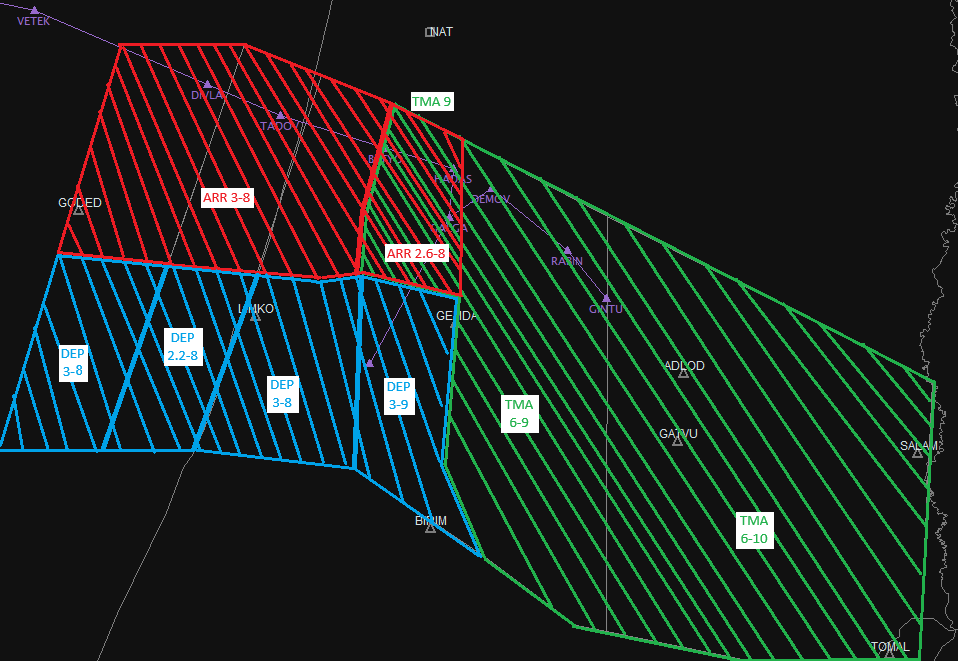
Annex B: APP-DEP-TMA SECTORS ILS 30
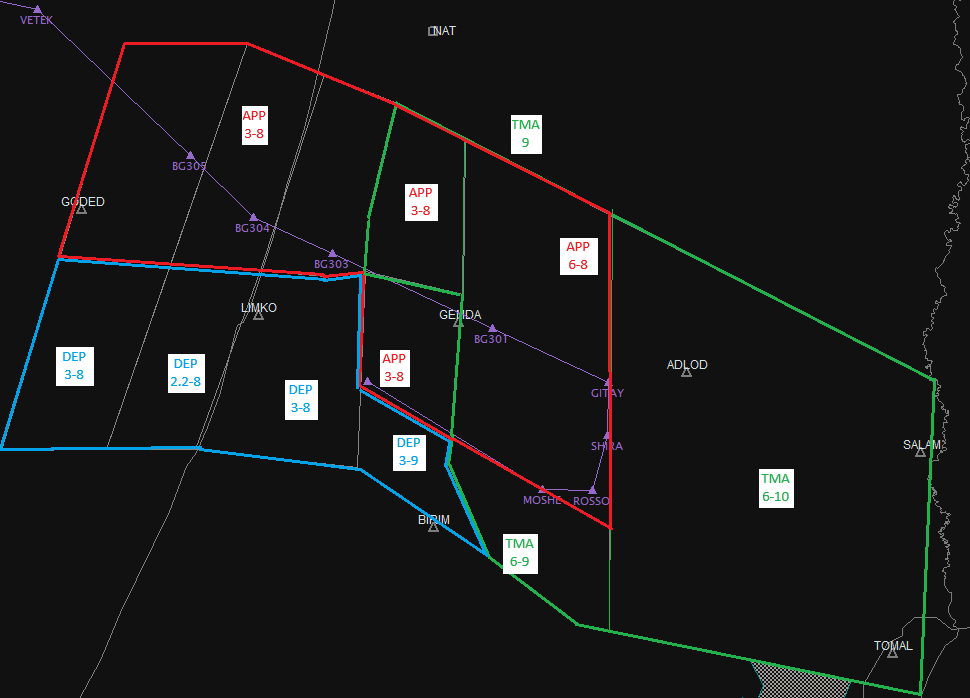
Annex C: APP-DEP-TMA SECTORS RNP-Z 30
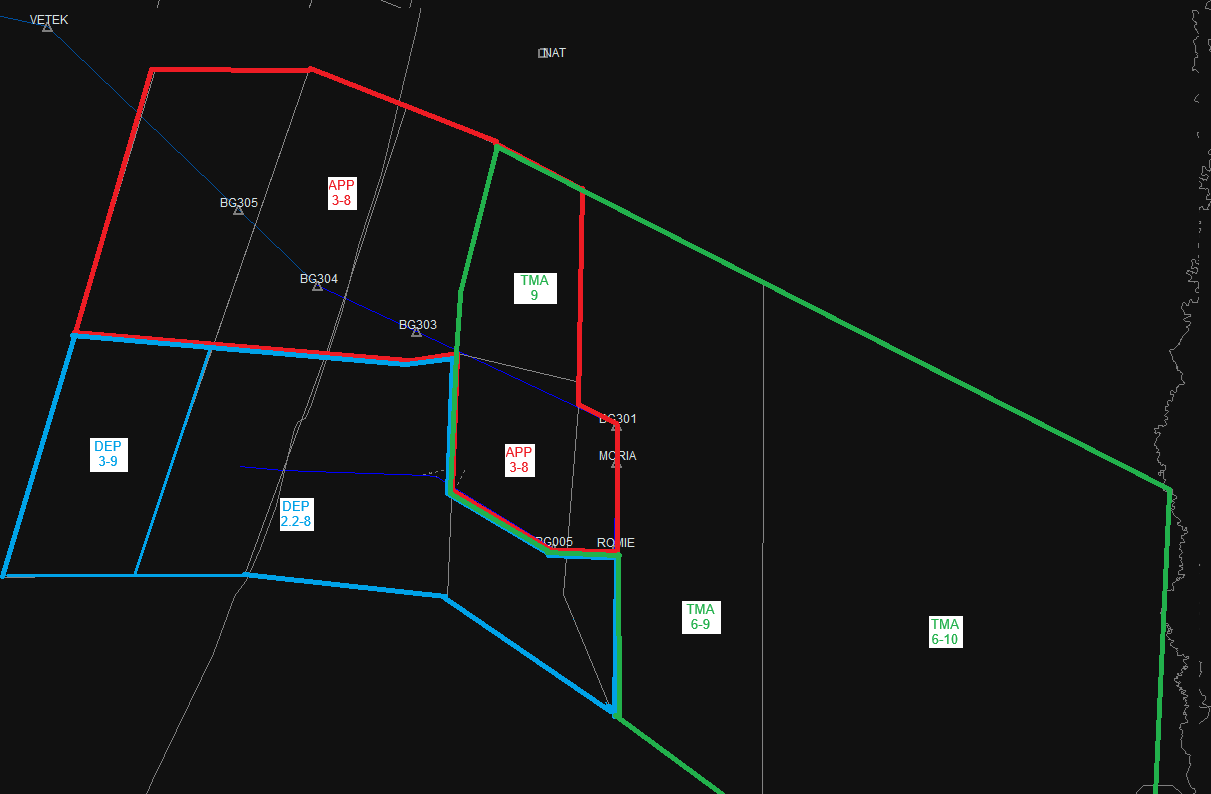
ANNEX D: APP-DEP-TMA SECTORS ILS 26
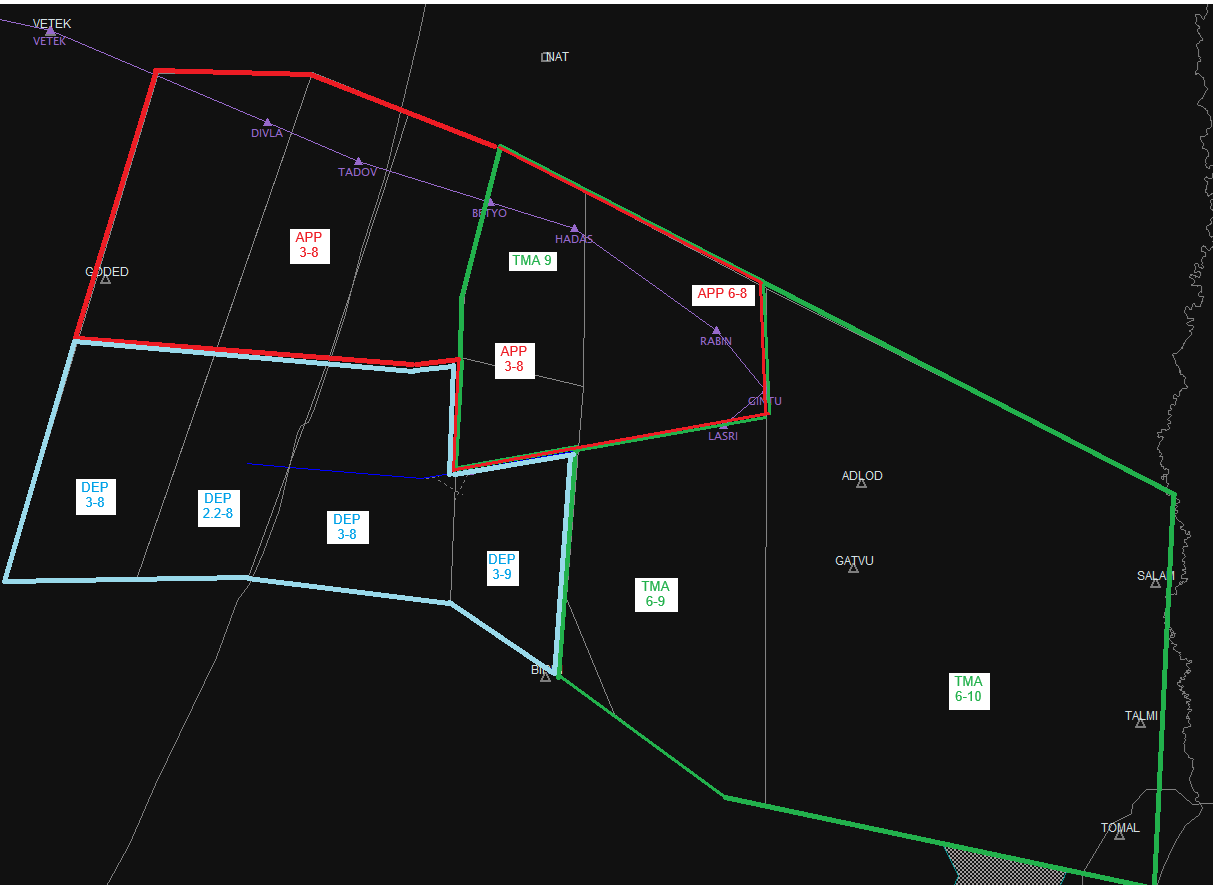
ANNEX E: APP-DEP-TMA SECTORS 08/08 OR 26/12 OR 12/12 OR South approach to 30
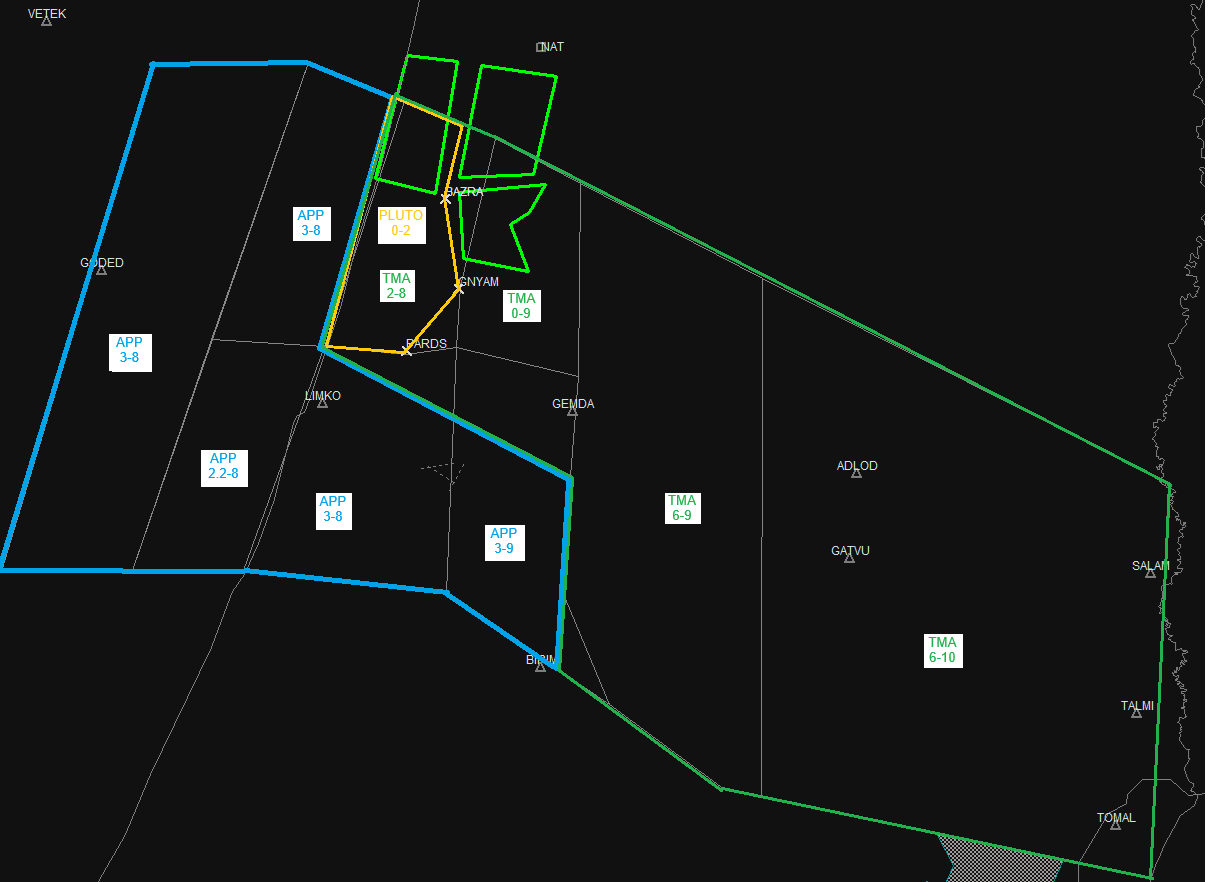
ANNEX F: Checklist switch to configuration 26/21
Reports
ü Pluto (Or Apollo)
ü ACCS (Specify about inbound to the TMA via SIVAK-TALMI-GATVU)
ü ACCN (Rerouting, Spacing, Working Freq)
Technical systems
ü Confirm ILS is active (NOTAM)
ü Confirm configuration is updated at Vatis
ANNEX G: Checklist switch from configuration 26/21
Staffing
ü Marge DEP sector into TMA
Reports
ü Pluto (Or Apollo)
ü ACCS (Back to normal routing)
ü ACCN (Rerouting, Configuration, Spacing, Working Freq)
Technical systems
ü Confirm configuration is updated at Vatis
ANNEX H: Checklist for integration to runway 30 while 26/21
· Intended to integrate between 3-1 planes for runway 30
|
Switch from 21 to 30 · Define to Radar and Tel-Aviv ACC: - Last Airplane to land on 21 - Last Plane to land on 30 · Coordinations: - Tel-Aviv 30NM between the last for 21 and the first to 30 - Tel Nof if required to active GAVRI/RNP-X (10 min before active and if online) · Brief the DEP controller: - Send the inbound traffic to 30 to TWR-DEP - No traffic shall cross LIMKO before the landing plane on 21 crosses the runway threshold |
Switch from 30 to 21 · Define to Radar and Tel-Aviv ACC: - Last Airplane to land on 21 - Last Plane to land on 30 · Coordinations: - Tel-Aviv 20NM between the last for 30 and the first to 21 - Tel Nof if were active GAVRI/RNP-X when finished · Brief the APP controller: - Inbound traffic to 21 shall not cross 6NM final before the landing on RWY30 crossed RWY30 threshold
|
Annex I: BGN APC Logon Order